Search This Blog

Showing posts with label university. Show all posts

Tuesday, September 13, 2011

Tradition meets technology: top universities using Apps for Education


(Cross-posted on the Official Google Blog)

Pop quiz: What’s significant about the number 61?

(a) Number of points required to win a standard game of Cribbage
(b) The country code to call Australia
(c) Number of Top 100 universities that use Google Apps for Education

As all Aussie Cribbage enthusiasts attending college in the U.S. may suspect, this is actually a trick question—all three answers are correct!

Today, U.S. News and World Report released their 28th annual ranking of the top higher-education institutions across the nation. While this list of schools represents traditions of academic excellence that span centuries, these institutions also clearly recognize the importance (and value) of modern technology in academia. We’re thrilled that 61 of this year’s top 100 universities have chosen Google Apps for Education to help improve communication and collaboration on campus.

We’re proud to see such historic institutions moving to the world of 100% web. Here are just a few of the schools from this year’s “Top 100” that have gone Google:
  • Yale University
  • Northwestern University
  • Brown University
  • Vanderbilt University
  • University of Notre Dame
  • University of Southern California
  • Wake Forest University
  • William and Mary
  • Brandeis University
  • Case Western Reserve University
  • University of Maryland
  • Boston University
  • Rutgers University
  • Clemson University
  • University of Minnesota
To show our appreciation to these great schools, and to help students better explore and evaluate their college options, we’re providing a year’s worth of free access to the U.S. News complete rankings for anyone who registers before Friday, September 16. Just sign up and you’re all set.

Finally, it’s not just about who is using Google Apps. We’re also interested in how students and staff are using Google tools to do amazing things inside and outside the classroom. Since 61 is the magic number, we’ve compiled 61 stories directly from students, faculty and staff at these universities: www.google.com/apps/top100schools.
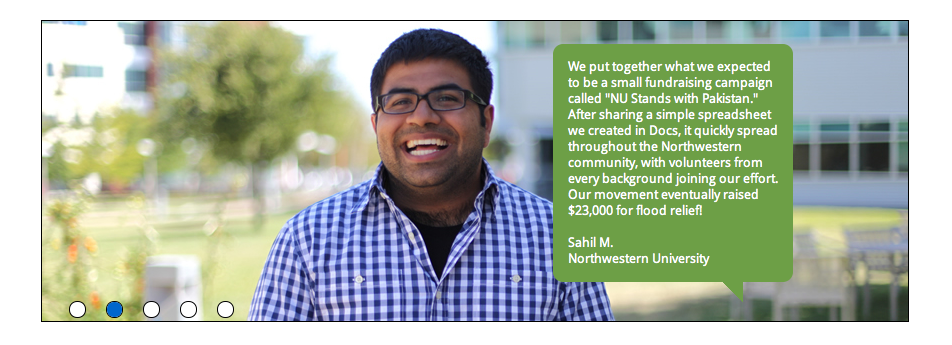

These 61 schools represent just a small portion of the 14 million students, faculty and staff now using Google Apps for Education. All over the world, Google Apps is helping schools offer their communities a better way of working together, and we’re honored to be a part of this new tradition.

Friday, August 19, 2011

North Carolina A&T State University goes Google


Today’s Official Google Blog post highlights the vital role that Historically Black Colleges and Universities (HBCUs) continue to play in the development of the African-American community, and demonstrates our ongoing commitment to ensuring these schools have the tools and resources they need to continue to blaze new trails and empower their students. As a recent grad from North Carolina Agricultural and Technical State University (NC A&T), I found the relationship between Google and HBCUs to be especially meaningful.


As with all schools, Google provides HBCUs with free and powerful tools for teaching and learning that help students, staff and faculty be more efficient, productive and collaborative on campus. At last week’s HBCU Summit, it was exciting to see nine more HBCUs join the Google Apps for Education family—in addition to the other 13 HBCUs that are already using Apps on campus—including my own alma mater.


As last year’s president of the Student Government Association of NC A&T, I remember countless conversations with students about how they wanted to see a better email system. The students wanted more up-to-date and user-friendly features to help them work and communicate better with fellow students and faculty. When I sat with campus administrators to present the idea of upgrading to Google Apps for Education, I never realized how simple the task could actually be.


I’m proud to see my alma mater on the cutting edge of innovation as they move to Google Apps for Education. Making the switch to Google Apps will give the A&T community the convenience and mobility that it desires. Barbara Ellis, Vice Chancellor of Information Technology says, “At NC A&T, we are always looking for opportunities to enhance services to our students. Google Apps for Education brings our email implementation into the forefront and allows us to embrace a technology platform that is relevant to our student population. Our relationship with Google is one that we can continue to build on.”


I am elated to be a part of a company that gives back to universities like my alma mater, and I’m honored to be a graduate of an HBCU gone Google. I know firsthand that everyone at North Carolina A&T State University—the faculty, staff, administration, student body and alumni—welcomes progress, change and innovation. Today, we proudly welcome Google!


The NC A&T team with Googlers at the HBCU Summit


Wednesday, July 20, 2011

UConn Goes Google: A Retrospective


In 1992, while I was an undergraduate at the University of Connecticut, some fellow students and I started an ambitious project to connect residence halls to the campus network and the Internet. After all, the web was just being created in ’92! At the time, our Lab Sciences House (Wright Hall, now gone... sniff... sniff) had a single mainframe terminal in what amounted to a large closet. The mainframe terminal was old, clunky, and not reliable or particularly useful. We wanted more.

The UConn administration bravely allowed my friends and I to design, deploy, and manage computer labs, networked dorm rooms, and most especially our own services. Personally I was really excited about our Gopher server*, but we also offered our classmates email, FTP, Usenet news, and a few shared applications like WordPerfect. In the 19 years since, campus technology has evolved – and so has UConn.

Today I’m especially proud to announce that my alma mater – UConn – is going Google. Associate Vice President and Chief Information Officer David Gilbertson says that the switch to Google Apps for Education stemmed from the recognition that students’ expectations about technology have changed dramatically in the past few years. This move to Apps will also bring significant benefits and cost savings to the University as a whole.

We Huskies were ahead of the curve in ’92, and we’re still at the cutting edge of campus technology today with our switch to Google Apps for Education. I know the UConn community will find amazing and innovative ways to exploit the tools Google is providing. And to all those students out there: even though you can’t knock on my door at 3am so I can fix the server anymore, rest assured the teams here at Google work 24 x 7 x 365 to make sure we’ll never be the excuse for your paper being late.

* Gopher was an early system for distributing, searching and retrieving information over the Internet. I thought it was really great that I could get National Weather Service forecasts for anywhere, whenever I wanted (you can still do this** via Gopher today!). Now though, I just ask my phone. Yep, the Internet has come a long way.

** Okay, that link is cheating – it’s using HTTP to get you to the gopher server – but chances are good your browser doesn’t even support the real Gopher.

Monday, July 18, 2011

Live Webinar: Introduction to Chromebooks for Education


Curious how the new Chromebook can help your school bring the power of the web to students and teachers? Join the Chromebooks for Education team tomorrow, Tuesday, July 19th or Wednesday, August 3rd at 11:00AM PT/2PM ET for an introduction to Chromebooks for Education live webinar.

Announced in May at Google I/O, Chromebooks for Education are now available directly from Google. Chromebooks are computers built and optimized for the web and give students, teachers, and administrators a simple solution for fast, intuitive, and easy-to-manage computing. The Education offering from Google also includes a web-based management console and three years of service and support from Google, so schools can get computers into the hands of their students and teachers at a much lower total cost of ownership than a traditional PC.

Teachers and students are already finding Chromebooks easy to use, and are using them as part of lessons ranging from feudal Japan to algebra. In Oregon, Zach Fleming has been using Chromebooks to teach 6th grade social studies at Crook County Middle School. "From the day the students got the Chromebooks, they were able get right to the lesson without much help. It’s pretty simple" he says, "individual learning at their own pace."

Matthew Peskay, the Director of Technology at KIPP LA Schools where Chromebooks have been a part of the classes for four months, is impressed that "there is no software to install and there is no application imaging that needs to be done,” meaning he can put “more computers out in the classroom, and easily sustain and maintain them over time.”


During the webinar, we will discuss Chromebook management capabilities, specific solutions for schools, and Google’s subscription pricing. You will also be able to hear from a teacher who has been using Chromebooks in their classroom and ask questions of Google’s Education Evangelist, Jaime Casap, who has been working with teachers and educators around Google Apps for five years.

Join us to learn how you can get Chromebooks in time for the start of the next school year. We hope to see you there!

What: Introduction to Chromebooks for Education
Who:
  • James Sanders, 7th grade history teacher, KIPP LA Schools
  • Jaime Casap, Education Evangelist, Google
  • Jeff Keltner, Chromebooks for Education, Google

When
  • Tuesday, July 19th, 2011 11:00AM PT/2:00PM ET - Register
  • Wednesday, August 3rd, 2011 11:00AM PT /2:00PM ET - Register

Friday, June 24, 2011

Big(ger) mail on campus


Around here, our mantra is “think big.” That’s why when we first released Gmail on April 1, 2004 we offered 1GB of free storage—more than 100 times what most other free webmail services offered at the time. No wonder people thought it was an April Fool’s joke! So you can imagine the laughs when we launched Google Apps for Education in early 2006 with 2GB of email storage, which in some cases was hundreds of times more than what schools were traditionally offering their students and staff. We continued adding more storage, and today we offer over 7GB of free email space for everyone using Google Apps for Education.

Now it’s time to think bigger yet again. Starting next week, new schools that migrate to Google Apps for Education will see 25GB mailboxes. Existing customers will see their mailboxes grow over the course of the next few weeks.

To celebrate 25GB inboxes, we’d like to recognize 25 of the schools that have recently gone Google:
  1. Amarillo College
  2. Anaheim City School District
  3. Ann Arbor Public Schools
  4. Boston University
  5. Buffalo State College
  6. Chaminade University
  7. College of Lake County
  8. College of New Jersey
  9. College of the Holy Cross
  10. Corning Community College
  11. Fall River Public Schools
  12. Harvey Mudd College
  13. HEC Paris
  14. Instituto de Empresa Business School
  15. Nebo School District
  16. New Haven Unified School District
  17. New York University, Stern School of Business
  18. Oshkosh Area School District
  19. Queen Anne’s County Public Schools
  20. Spring Independent School District
  21. University of Maryland Center for Environmental Science - Center Administration
  22. University of Maryland in Baltimore
  23. University of Northern Iowa
  24. University of Salzburg
  25. University of Richmond
We know students and teachers are really busy. There’s no reason they should spend their time sifting through spam and deleting email to stay under quota. We hope bigger inboxes might offer the first step to helping today’s students think bigger.

If you’re interested in bringing Google Apps to your school, let us know.

Thursday, June 16, 2011

Reflecting on a school year with Google Apps for Education


As school lets out and summer vacation begins, the Google Apps for Education team has been reflecting on what we've learned from our users over the past school year. We wanted to share some of the great stories we've heard from students and teachers in Colorado, Canada, Brown University, and Iowa.

Littleton Public Schools (LPS) in Colorado decided to "go Google" in the fall of 2010 and students are giving Google Apps high marks for working on collaborative projects. High school sophomore Kylie shares, "we no longer have to exchange contact information because everyone already has a Google account and it is saved in our contacts. We are also easily able to create either a Google doc or group for the project, and can invite the teacher as well to look at our work." Other LPS students Rachel and Bekah find that editing together in Google Docs "improved our writing by sharing with others and making comments at the same time" and working with documents stored online made it "easier to be organized and bring home assignments." And 5th grade student Jonathan likes Google Apps for the practical reason that "you don’t have to worry about paper getting lost and having your things get torn or ripped."

Before and after the faculty and staff at Littleton Public Schools have "gone Google."

Teachers from Edmonton Public Schools in Alberta, Canada are finding that Google Apps is increasing students’ engagement and saving teachers time. One teacher notes that "students love having the option to complete assignments online and homework completion has improved drastically." Another educator observes "moving to a web-based platform has made distributing, sharing, and collecting material seamless. It has significantly decreased my workload and planning, as I do not need to create several different versions of things."

Brown University’s undergraduates moved to Google Apps in the summer of 2009; the rest of the campus migrated the following year. This May, Brown asked the entire campus community -- faculty, staff and students -- to evaluate their satisfaction with and use of Google Apps. The results are overwhelmingly positive: nine out of ten members of the Brown community said they were “satisfied” or “very satisfied” with Gmail, and overall satisfaction has actually increased since the initial deployment. The detailed survey results are available at www.brown.edu/cis/GoogleApps/survey.


At Clear Creek Amana Middle School in Iowa, the benefits of Google Apps extend beyond organized lessons. The "Creek Squad," a tech support team made up entirely of student volunteers, helps teachers and administrators get the most out of the technology at their fingertips. With Google Apps, it seems, the students really have become the teachers!


While school may be out for students and teachers, we're excited to spend the summer coding away to make sure that when classes start again in the fall, Google Apps is better than ever.

Tuesday, March 29, 2011

The Power of the Apps Marketplace: A Webinar with CloudLock and Boise State

Thousands of institutions have adopted Google Apps for Education and already enjoy the tremendous collaboration boosts and cost savings that come along with it. Many, however, may be less familiar with the Google Apps Marketplace (not to mention the recently launched Education category in the Marketplace which includes applications for student tools and teaching aids). As the Apps Marketplace celebrates its first birthday, we invite you to learn how one Google Apps customer has deployed an innovative Google Docs management app from the marketplace and how it has impacted the visibility of collaboration and sharing within their organization.

Join us for a webinar on April 7th at 11am PST to hear Boise State University’s Brian Bolt, the Office for Information and Technology Team Lead, share how they are using Google Apps and CloudLock from the Google Apps Marketplace. Brian will share his lessons on rolling out Google Apps and demonstrate how CloudLock addresses some of the core IT control and visibility requirements they faced when moving increasing amounts of their organization’s data to the cloud. Specifically, Brian will cover how CloudLock helps to address:
  • Governance - Managing access to data to mitigate unauthorized access
  • Protection - Define and enforce document ownership and sharing policies
  • Analytics - Understanding how to effectively make sense of data
CloudLock’s Co-Founder, Tsahy Shapsa, will also share how their app has made it possible for organizations to extend their Google Docs repositories in order to begin to retire their legacy on-premise file servers, effectively producing a significant ROI with real hard and soft cost savings. We hope you’ll tune in to hear more about how Boise State has leveraged CloudLock.

The Power of the Apps Marketplace: A Webinar with CloudLock and Boise State
Thursday, April 7th, 2011
11:00 a.m. PDT / 2:00 p.m. EDT
Register here

Posted by Jordan Pedraza, Google Apps for Education Team

Monday, March 21, 2011

The Green and Gold Goes Google

After many months of planning, today the University of Alberta – one of Canada's largest research-intensive universities – will begin providing its faculty, staff and students with Google Apps for Education. About 40,000 students will start making the switch today, with faculty and staff following over the coming months. This agreement paves the way for other Canadian institutions to go Google.

Jonathan Schaeffer, the University’s Vice Provost for Information Technology, says: “This is good news for the University of Alberta. Moving to Google will ultimately have a positive and transformative effect on teaching and learning on campus.” The migration will not only improve campus-wide communication and collaboration, but will reduce the current 80+ independent email servers on campus to one single system for everyone.

In the US, we are also thrilled to welcome some of the other schools, colleges and universities that have recently joined the family of more than 11 million users of Google Apps for Education, including:
  • Douglas County School District
  • Humboldt State University
  • Lakeshore Technical College
  • Linn-Benton Community College
  • Madison Metropolitan School District
  • Santa Barbara City College
  • St. Joseph School District
  • SUNY Fredonia
  • Township High School District
  • University of Wisconsin, Madison
  • Western Oregon University

Thursday, March 17, 2011

College Basketball 2011: Over 50% of the bracket has gone Google

[Cross-posted from the Google Student Blog]

March is a special time for college basketball enthusiasts as the NCAA® Championship games heat up. This season is especially exciting for us on the Apps for Education team to watch, as more than half of the teams in this year’s tournament have Gone Google – meaning they’re using Google Apps for Education on campus.

With more than 11 million students, faculty and staff who are already part of the Google Apps “squad” – providing their campus community with collaboration and communication tools – we’d like to congratulate the 37 Apps schools who are vying for the championship and wish them luck with the rest of the tournament, including:
  • Alabama State University
  • Belmont University
  • Bucknell University
  • Clemson University
  • Gonzaga University
  • Notre Dame
  • Old Dominion University
  • San Diego State University
  • Temple University
  • University of Akron
  • University of Arkansas at Little Rock
  • University of Illinois at Urbana Champaign
  • University of Kentucky
  • University of Nevada, Las Vegas
  • University of Texas at San Antonio
  • University of Southern California
  • University of Washington
  • Utah State University
  • Vanderbilt University
  • Villanova University
For information about how to become a 100% web campus, please visit google.com/apps/edu. While we’re sorry to say we can’t promise any success on the basketball court, you can at least make your own bracket a "slam dunk" with the Google Docs bracket template!

Tuesday, March 8, 2011

Google Apps for Education 101: Webinar Series

Interested in joining the thousands of schools and millions of students, staff and faculty currently using Google Apps for Education? We’ll be holding a webinar series in March that will help you do just that.

These webinars will cover a number of topics - from an overview of Google Apps and its services to a deep dive into the Google Apps control panel. These webinars will be run by members of the Google Apps for Education team who can share lessons learned and best practices. Feel free to register for one session or the entire series. Hope you’ll join us for Google Apps for Education 101!

Register to attend one of the upcoming webinars in the series:
March 16, 10:30AM PT/1:30PM ET: Pitching Google Apps at your school
March 22, 10:30AM PT/1:30PM ET: The A to Z of a Google Apps Deployment
March 24, 10:30AM PT/1:30PM ET: What can the Google Apps control panel do for me?
March 30, 10:30AM PT/1:30PM ET: We’re going Google: marketing and project planning

Archived recordings from past Google Apps for Education webinars can also be found in our resource center.

Friday, February 25, 2011

Guest Post: Google Docs for Classroom Instruction

[cross-posted from the Google Docs blog]

Guest Post: Philip Greenspun is a pioneer in developing online communities and an educator who has taught electrical engineering and computer science courses at the Massachusetts Institute of Technology since 1987.Today he explains how he used Google Docs to develop and distribute curricular materials and to support in-classroom discussion of student solutions.

In 1983, I began building applications to support multi-user collaboration over the Internet. When I began using the World Wide Web in 1993 I vowed never to write a native application program again and said "every desktop computer program going forward should simply run in a Web browser." Since the main reason to prepare a document was for others to view, I predicted that everyone would be using browser-based word processors and spreadsheet programs by the year 2000. I am still waiting for my "everyone goes to work in a flying car" prediction to come true also...

In January 2011, four of us were developing an entirely new course for MIT students, an intensive lab-based SQL programming and Android development class. All of us are proficient Web developers accustomed to authoring pages in standard text editors and publishing them on our own servers, but it turned out to be easier and more effective to use Google Docs to collaboratively develop course materials. Google Docs was more effective because simultaneous updates could proceed in different areas of a document and we weren't slowed down by having to do explicit check-ins with a standard version control system (or circulate drafts with names such as "DayOneProblems-final-version-by-philg-really-really-final"). Also, the "insert a comment" feature of Google Docs proved useful, e.g., when I wasn't sure if an example program was correct and wanted to ask a collaborator to check, but without leaving crud in the main body of the document.

We created two Google Docs folders the night before class: lessons, editable by us and view-only for students; workspace, editable by everyone. Into the "lessons" folder we moved the first day's assignment. In the "workspace" folder we created a "Day 1 Workspace" document intended for students to cut and paste code into. As each student walked into the classroom, we asked him or her to email a teacher from his or her Google Account (most students already had Gmail and some experience with Google Docs) and the teacher would share both folders with the new student, immediately enabling access to all lessons.

As the course materials had never been used before, they contained some errors and many sections that lacked sufficient hints or explanations. When we noticed these deficiencies, e.g., when a student asked a question, we would edit the problem set from a teacher's laptop and all students would immediately see the change on the projector and/or on their own screens.

Google Docs enabled us to distribute solutions incrementally. The first morning we created a "Day 1 Solutions (January 2011)" document and dragged it into the lessons (view-only for students) folder. As the day progressed, when 90 percent of the students were done with a problem, we would add the solution to the end of this document (by copying from another Google Doc, of course) so that students would have it in front of them and be prepared for the discussion.

The shared Google Docs workspace documents enabled us to have students paste their work into shared documents that could be used for projection and discussion and also for members of the class to try out each other's SQL queries.

To gather feedback at the end of the course, we simply created a feedback document and put it into the workspace folder, then used the "email editors/viewers" feature (from the Share menu) to ask students to add their thoughts, including whether they liked Google Docs ("great for sharing solutions"; "very effective"; "Generally yes, I did get a little confused with all the browser tabs I had open"; "very efficient and comfortable"; "green too").

We were technical people teaching a technical course, but everything that we did with Google Docs would have been easy for a person without any programming or HTML authoring background. Google Docs was an important asset for our course and significantly enhanced the in-classroom experience.

You can read more about our experience, including our wishlist, at http://philip.greenspun.com/teaching/using-google-docs-for-classroom-instruction

Tuesday, February 1, 2011

Going Google: A Guide for Schools and Universities

We talk a lot about “going Google”, and with more schools and universities – like Ann Arbor Public Schools, Bryant University, Bucknell University, Henry Ford Community College, NYU, Oklahoma State University, and Southern Oregon University – migrating to Google Apps for Education every day, we want to help make it as easy (and fun) as possible to make the move.


Whether you are just thinking about launching Apps, or you’re toasting to your first graduating class after four years in the cloud – it’s always a good idea to educate your users about the new ways they can teach and learn with Google Apps. With that in mind, we’ve created the new Guide to Going Google which provides tools and resources that help students, faculty, staff and alumni make the most of your transition. The guide outlines six steps to successfully going Google: technical deployment, outreach, training, getting the word out, going live, and staying up to date. We designed this guide to be helpful for everyone from a 4th grade teacher in a classroom that’s just learning about Google Apps, to a university CIO that’s been using Apps for years.


Of course, if you’re still evaluating hosted collaboration tools for your school, and want to understand why so many schools have already gone Google, take a minute to hear what CIOs at Kent State, Brandeis, North Carolina State and U.C. Riverside are saying about making the move to Apps:


P.S. For those schools who have already gone Google, we'd love to hear and see your creative approaches to making the transition successful. Maybe you brought your mascot the a faculty training like they did at Brown University; or had a special group of on-the-ground trainers like the Creek Squad. Maybe you did something bold like NC State who created a graffiti wall to mark the occasion of your launch. Let us know how you’ve gone Google, so we can help other schools can get inspired, too.


Posted by Dana Nguyen and Miriam Schneider, Apps for Education team

Monday, November 29, 2010

Extra Credit: What more can you do with Apps for Education?

Update December 17, 2010: Added links to webinar video recordings.
Is your school already using Google Apps for Education? Want to move beyond the basics, and learn how to customize, integrate, and extend Google Apps on your campus?

This December, we’re kicking off a series of free “Extra Credit” webinars covering advanced topics for IT leaders in education, such as integrating Google Apps with LMSes (learning management systems), SISes (Student Information Systems), and other common learning programs, like student e-portfolios.

We’re excited to have experts from Northwestern University, Truman State University, Clemson University, SunGard Higher Education, and Appirio, Inc. sharing their experience and learnings in this first set of webinars, running December 6 - 9, at 11AM PST daily. Topics will include:
  • What EDU can learn from Enterprise deployments [video]
  • Google Apps as an Eportfolio solution at Clemson U. [video]
  • Integrating Google Apps and Blackboard with Bboogle at Northwestern U. [video]
  • Integrating Google Apps with SunGard Higher Education ® products at Truman State U. (includes Luminis 5 / Google Apps demo) [video]

Learn more, and reserve your spot at google.com/apps/extracredit. Registration is free.

Friday, October 22, 2010

Plugging into Google Apps for Education: partners, platforms and products

Last week, we celebrated a big milestone for Google Apps for Education: 10 million active users. While a lot of the credit belongs to the school IT leaders and teachers who recognized the collaboration and learning potential of services like Google Docs, Google Sites, and school-wide Gmail, we’d be remiss if we didn’t also mention the many partners and integration projects that have helped support Google Apps for Education.

We were lucky enough to have several of these partners join us in our EDUCAUSE booth last week, and share how they’ve helped deploy and connect Apps with many widely-used learning management systems in higher ed. If you weren’t able to make it to these sessions in our conference booth, here’s a recap of how schools can integrate Apps with the technology platforms commonly used by colleges and universities today:

Blackboard + Apps: Northwestern University’s Bboogle project is a free, open-source integration that lets schools integrate Google Apps with Blackboard’s learning management system. This video and case study shows how a history professor at Northwestern used Google Sites to create a collaborative encyclopedia with his students; Bboogle managed authoring permissions for the class and provided links between the Blackboard course site and Google Sites.

Sakai + Apps: rSmart showcased the new Google Apps functionality that’s available in the upcoming 2.7.1 release of their Sakai collaborative learning environment. Sharing a Google Doc in Sakai now lets Sakai handle which users have access – often a volatile course roster as students drop and add classes – without having to manage a separate list of usernames with Google. For a sneak peek, check out this video and case study.

Moodle + Apps: Moodle solutions provider Moodlerooms displayed the single sign-on, automatic user provisioning, and Google Apps widget integration available in joule™. More information is available in this case study, or the related Moodle-Google open-source code.

MyCampus + Apps: The CampusEAI Consortium’s student portal solution includes an out-of-the-box Google Apps integration that’s used by over 50 universities and colleges, allowing students to engage with Google Apps without leaving their portal environment. A case study is available here.

We also owe a hat tip to the leading Google Enterprise Partners who joined us at EDUCAUSE, like Appirio, who shared their plan for training faculty and staff at Brown University, LTech, whose ‘Power Panel’ app allows limited administrators (ideal for university helpdesk staff), and SADA Systems, who explained the opt-in, on-demand content migration solution they developed for Kent State.

We’re impressed with how these partners have used our open APIs (plus App Engine and the Apps Marketplace) to make Apps even more useful to schools, and we look forward to sharing even more success stories in the future!


Thursday, October 14, 2010

Strike up the band: over 10 million have gone Google with Apps for Education

(Cross posted on the Official Google Blog)

It was four years ago this month that Google Apps for Education first touched down, right before a pivotal football game between ASU and USC—fatefully enough, two schools that were among the first to move to Google Apps and pave the way for other schools to adopt this “alien technology.”

This week at EDUCAUSE we’re celebrating with these schools and the thousands of others that make up more than 10 million students, staff, faculty and alumni that are actively using Apps for Education on campus. We figured that nothing was more fitting than a tailgate celebration to toast the colleges and universities that have “gone Google.” And of course, it’s not really a party without inviting the marching band.


In the last four years we’ve seen a lot of changes, both to our tools and the general landscape of cloud computing in higher education. According to the 2010 Campus Computing project, nearly 85% of four-year colleges and universities are already using or considering moving to the cloud by offering hosted email to their students. Of those schools that have already made the move, more than 56% of them have gone Google.

As part of this sustained momentum, we’ve seen the number of active Google Apps for Education users double since last fall, with more than two million new users coming on board since May alone; not to mention the emerging growth we’re now seeing in the K-12 space.

Hundreds of schools have made the move to Google Apps just this year, including Gonzaga University, Barnard, Brown University, William and Mary, Villanova University, Georgetown School of Business, Case Western Reserve University, Hawai’i Pacific University, Brandeis University, more than half of the 23 campuses in the California State University system, Morehouse College, University of Illinois at Urbana-Champaign, Texas A&M Alumni, University of Tennessee Chattanooga, 13 of the SUNY schools, Pace University and Wilfrid Laurier—to name just a few.

The USC Trojan Marching Band helped us give a spirited cheer to the schools who have gone Google and the progress we’ve seen in the last four years. But like any good commencement address will tell you, this is only the beginning.


Friday, August 6, 2010

Seventh U.S. state is fourth to head to the cloud

Today we’re happy to announce that The Maryland Education Enterprise Consortium (MEEC) will make Google Apps for Education available to 1.4 million students in the state. MEEC is comprised of the University System of Maryland, Maryland Higher Education Commission and Maryland Department of Education, and provides software resources and services to its 194 members across the state. This includes all 24 public K-12 districts, libraries and all public and private higher education institutions.

Maryland joins the ranks of Oregon, Colorado and Iowa, who each enabled their educational institutions to “go Google” under one statewide agreement. And more than 8 million other students, staff and faculty across the globe actively use our free messaging and collaboration suite.

In addition to Google Apps, this agreement also enables MEEC member institutions—for example University of Maryland, Baltimore County (UMBC)—to license Google Postini Services such as Google Message Security, for use with the existing email infrastructure to enhance Spam filtering and email security for students, faculty and staff.

According to Assistant Vice President of IT at UMBC, Mike Carlin, students were overwhelmingly in favor of Google and vocal about their preference when it came to email since it “works exceptionally well with their mobile lifestyle.”

Posted by Miriam Schneider, Apps for Education Team

Tuesday, June 29, 2010

Brown University has gone Google

From time to time we invite guests to blog about initiatives of interest, and are very pleased to have Geoff Greene join us here. Geoff is the Director of IT Support Services at Brown University, and here he shares an update on their campus-wide migration to Google Apps for Education for all students, staff and faculty. - Ed.

About a year ago we put our 6,000 undergraduate students on Google Apps. The results were phenomenal: people were happy, they were productive, they were excited...and then some people got jealous. Our faculty and staff members started coming to us asking “When do we get to go Google?” Turns out they also wanted access to the same tools to better connect and engage with students and with each other.

We thought about it for a bit and realized that they had a point. So we decided to bring the entire Brown University community together—faculty, staff, medical and grad students—with a common set of tools: Google Apps for Education. This summer, our Computing & Information Services team is in the process of migrating everyone to our new GoogleApps@Brown system. The positive experience our undergrads have had using the Apps suite helped our Provost David Kertzer decide that the change would bring significant benefits and cost savings to the university as a whole. In fact, we predict this change could save us somewhere around $1 million each year.

Our students were really the ones that led us down the Google path. They knew these tools would work because they already used them in their non-school lives. We also decided to go this direction because of the functionalities that we believe will bring our university together, namely tools like collaborative documents, better email (with nearly 30 times the storage space we had with our previous system!) and video chat.

The icing on the cake is that we signed a zero dollar contract for all these top-notch tools. But it’s not just about saving money—it’s also about investing in our university’s future. Google Apps helps us work better together, and we can feel the excitement building on campus as a result. Here’s a little glimpse:


Since some faculty and staff members aren’t as familiar with the new tools just yet, we also hosted a “roadshow” to spread the word and gear up training sessions tailored for each campus group or department. Our training efforts are robust (you can check it out at training.brown.edu) and we have Google Guides—enthusiastic staff and student volunteers—helping their peers with the transition. We feel confident that once people start using these tools together, they’ll never look back.

Posted by Geoff Greene, Brown University Computing & Information Services

Wednesday, February 17, 2010

Seven million students have gone Google...and we're road tripping!

Editor's note: We're sharing some news – and a cross post from the Official Google Blog – about a new milestone for Google Apps Education Edition: use by 7 million students and faculty worldwide.

Since the fall of 2009 we've seen more and more students and faculty take advantage of Google Apps Education Edition. We've seen our active users grow – first we had 5 million, then 6 million, and today we're happy to announce that we've crossed the 7 million mark. With so many students and faculty using Google Docs, Google Sites, and Gmail to collaborate and share their academic work, we figured it's the perfect time to hit the road and help more schools see Google Apps in action.

Beginning in April, the Google Apps Education team will travel to universities across the southern and eastern US to meet with regional CIOs and IT directors in higher education. We'll be hosting these events with some great universities using Google Apps, including Hofstra, Columbus State University, the University of South Florida, Texas Southern University, and the University of Virginia.

At every stop, the host universities will share how their students and/or faculty use Google Apps, and show how they've deployed and connected Apps within their technology infrastructure. We'll be devoting a lot of time for questions and we'll have plenty of demos from the Google Apps team. If you're a university CIO, CTO. or IT Director in New York, Florida, Georgia or Virginia (or nearby!) and would like to join us at a roadtrip stop, please let us know via this contact form. We hope to see you there!

Google Apps Education Edition CIO Roadtrip - Spring 2010

4/16 : Hofstra University
(in conjunction with the New York Higher Education Technology Forum)
Hempstead, NY

4/19 : University of South Florida
Tampa, FL

4/21 : Columbus State University
Columbus, GA

4/23 : University of Virginia
Charlottesville, VA

Early June : Texas Southern University
Houston, TX

Posted by Jason Cook, Google Apps Education team

Thursday, October 15, 2009

Faculty and staff are going Google, too

September was a big month for Google Apps Education Edition as everyone headed back to school. When we announced five million active users in early September, we didn't expect that it would only be about a month before we would announce that more than six million students, staff, and faculty at schools worldwide are now actively using Google Apps at school.

We talk a lot about what students want and need (and we also try to learn from them as much as possible), but it's important to remember that these six million users aren't only students – they are also faculty and staff members using Google Apps technology in education.

The cloud is all about collaboration, and this means not only students working together, but also students working with their teachers and professors to improve learning outcomes and save time. Using internet-based solutions like Google Apps to enhance the cycle of lesson, evaluation, and adjustment can shorten what used to take days or weeks into minutes, and collaborating in the cloud helps educators connect more effectively with students.

There are lots of examples we're seeing crop up on campuses. For example New York City's Intermediate School 339 ensured clear communication between students, teachers, and the community by moving the entire campus to Google Apps, and taking advantage of features like forms in Google Docs to create real-time quizzes helped to double Math performance scores, increase attendance, and build student engagement.

And, after Boise State University migrated their 2,400 faculty and staff to Google Apps, not only were they able to foster better collaboration between students and staff, but they reduced costs for IT infrastructure, support, and maintenance by $90,000 annually.

Other schools that have chosen Google Apps for their faculty and staff include Temple University, Columbus State University, Abilene Christian University,
Macalester College, Manhattan College, Mary Baldwin College, Northeastern State University, and Saint Louis University (including 8,500 staff from their Medical Center and Hospital).

We strongly believe that when all education users - from students to professors to school administrators - have access to cloud-based tools and aren't limited by where or when they work, it enhances their ability to communicate and collaborate effectively. So come on, Go Google and join these schools (and many others) in the cloud with Google Apps.

Posted by Miriam Schneider, Google Apps Education Edition team

Learn more about what's possible for your school with Google Apps Education Edition.

Thursday, October 8, 2009

UK Universities going Google

Last month, we announced that over 5 million students were actively using Google Apps Education Edition. Today, we're pleased to note that several noteworthy universities in the UK have joined this growing movement by announcing plans to deploy Google Apps for the coming academic year.

The University of Sheffield, Sheffield Hallam University, the University of Portsmouth and De Montfort University are the latest to sign on with Google Apps, joining established UK Apps users like the University of Westminster and Leeds Met.

We recently mapped Google Apps' adoption in schools across the globe, but we think it's just as interesting to hear how students from the University of Portsmouth are logging in from 26 countries in 10 languages while studying abroad – all in the first month of using Apps. With tools like integrated video chat and real-time collaboration, Google Apps are working in the cloud to make the world a little bit smaller, while making campuses larger than ever.

To read more about UK universities that have gone Google, click here.

Posted by Jason Cook, Google Apps Education Edition team

Learn more about what's possible for your school with Google Apps Education Edition.
Related Posts Plugin for WordPress, Blogger...