Search This Blog

Showing posts with label Aconcagua. Show all posts

Tuesday, February 22, 2011

Sherpa Climbs Seven Summits In 42 Days


Way back last March of last year I posted a story on Ang Chhiring Sherpa, who at the time was attempting to set a speed record for climbing the Seven Summits. Fast forward a year, and he has accomplished his goal and in highly impressive times.

According to this story, which is in French, (use Google Translate), A.C., as he has known, managed to knock off each of the seven summits in just 42 days of accumulated climbing. That's the amount of time he actually spent on the mountains itself, and not his his total time from start to finish of all of the mountains. The individual times for each of the peaks looks like this: Mount McKinley- 12 days; Kilimanjaro - 16 hours, 37 minutes round trip!); Elbrus - 8 hours, 14 minutes; Kosciusko - 2 hours, 32 minutes; Aconcagua - 7 days; Vinson - 4 days;  and Everest - 19 days.

A.C. actually finished off his quest last may when he completed his climb of Everest, but I hadn't seen confirmation of his final time until this story was send my way by Louis-Philippe Lonke earlier today. While the news might be old, it is still a very impressive time and accomplishment that deserves a salute.

It should also be noted that A.C. wasn't making the climb just to achieve a record. He was also raising funds and awareness for the Himalayan Women & Children Foundation, an organization dedicated to helping to educate women and provide basic health care and other services for those living in the Himalayan mountains.

A worthy cause to say the least.

Thursday, January 27, 2011

7 Summits Climb For Alzheimer's: Camp 2 On Aconcagua


It has been about a week and a half since we last checked in on Alan Arnette. At that time he was in Argentina, where he was preparing for the trek to Aconcagua, the highest peak in South America, and next on his Seven Summits hit list. Since that time, he has not only arrived on the mountain, but has been working hard to help shuttle gear to the high camps in preparation for the summit push. Yesterday, he and the rest of the team were in Camp 2, located at 18,000 feet (5486 meters), with plans to move up to High Camp today. With their gear in place at that location, they'll be all set for their final push when the weather allows.

For Alan, hiking around Aconcagua is like visiting an old friend. He has successfully climbed the 22'841 foot peak (6962 meters) on two other occasions. But Alan is also a safe and deliberate climber who doesn't take anything for granted. I can assure you that he doesn't look at this summit as a fore-gone conclusion, and he is focused on getting up and down very safely.

For those who aren't aware, Alan is climbing the Seven Summits to raise $1 million for the Cure Alzheimer's Fund. Since announcing this project back in November, he has already successfully climbed Mt. Vinson in Antarctica, and after Aconcagua he'll move on to Everest, a mountain that he has also been on several times in the past. Most Seven Summiteers wait to do Everest last, but Alan will make it the third peak on his list.

Good luck on Aconcagua this week Alan! Climb on!

Monday, January 17, 2011

7 Summits Climb For Alzheimer's: Alan's Off To Aconcagua!

This past weekend, our friend Alan Arnette flew off to Argentina where he is attempting to climb Aconcagua, the tallest mountain in South America, as part of his 7 Summits Climbs for Alzheimer's. Alan is currently en route to the mountain, which stands 6962 meters (22,841 ft) in height. While it is a mostly non-technical climb, at least along the regular route, the altitude alone is enough to cause some problems for those that are unprepared.

Alan will not arrive in BC for a few more days yet, as he and his IMG guides are now in Mendoza awaiting the rest of the team and preparing the last of their gear before purchasing their climbing permits for the mountain. Expect good updates at every step of the process, as Alan always does an excellent job of keeping us informed of his progress and giving great insights into what it is like to climb the mountain he is currently on. I expect no less this time, especially considering that he has already successfully climbed Aconcagua in the past.

An example of Alan's great work is the video below, during which he talks about his prep work for the mountain and shows off the gear he's using on this climb. He doesn't just show us the individual pieces however, as he actually shows us each piece in regards to where it is used during the climb. It is very insightful for those that wonder where all that gear is put to use.


Tuesday, August 10, 2010

Top Mountaineering Expeditions For Beginners

Outside Magazine's Adventure Adviser has a great post today answering the question: "What are the best beginner-level mountaineering expeditions across the world that a regular, fit trekker can attempt?" Seems like a natural question for fans of the outdoors who are looking to get into high altitude mountaineering for the first time.

And what does the Adviser recommend? His "very subjective" list of the top five mountains for beginners to cut their teeth on.

1. Mount Baker, Washington (10,781 feet)
2. Kilimanjaro, Tanzania (19,340 feet)
3. Mount Khuiten, Mongolia (14,350 feet)
4. Mount Elbrus, Russia (18,500 feet)
5. Aconcagua, Argentina (22,840 feet)

Quite a good list, as you have a strong start to the Seven Summits and a couple of other challenging, yet scenic and spectacular climbs. None of these incredibly technical, and the biggest obstacle would be dealing with altitude, but they'll give you some skills that you can take on other climbs, and a taste of what it feels like to get up into the thinner air.

What do you think? Anything that should be added to the list? I was thinking about the 18,491-foot tall Orizaba in Mexico as a possible addition and obviously something like Rainier, at 14,411 feet, which is a popular mountain for potential climbers to cut their teeth.

Any other suggestions?

Tuesday, June 22, 2010

Another Young Mountaineer Climbs For A Cause

We've all marveled at the stories of Jordan Romero, who at the age of 13 became the youngest to summit Everest last month. Last week, Mountain Hardware introduced their newest, and youngest, sponsored athlete, in the form of 12-year old climber Matt Moniz. Even at that tender age, Matt has already managed to successfully summit Denali, Whitney, and Mt. Elbert, the tallest peak in the Rocky Mountains. Even more amazing, he did all three of those in just eight days!  He has also been up Aconcagua, Kilimanjaro, and Elbrus, and made the trek to Everest Base Camp as well.

While Matt clearly loves to climb, and doesn't lack skills in that department either, he also is climbing for a cause. He hopes to raise funds for research on pulmonary arterial hypertension (PAH), high blood pressure in the arteries of the lungs. Matt's best friend, Iain Hess, suffers from PAH, and the young climber hoped to dedicate his expeditions toward helping his pal in any way that he could. 


Last year in July, Matt set out to climb 14 of Colorado's 14ers in just 14 days, and in the process he raised $20,000 for his cause. It helped to establish the Iain Hess Breathe Easy Fund. Turns out, it only took Matt and his team, 8 days to bag those peaks. 


This is a great example of a young adventurer who seems to love what he is doing, and has a good cause that he is trying to support. I loved this story when I read it, and thought it was worth sharing here too. Great story!

Friday, February 12, 2010

Chad Kellogg Completes New Route On Aconcagua


American climber Chad Kellogg has completed a new route on Aconcagua, going up solo and in alpine style, up the South Face. According to this story, courtesy of ExWeb, the new route took 42 hours to complete, covering more than 2000 meters (6561 feet) of new terrain in the process.

According to ExWeb Chad went to Argentina, along with a good friend, back in December with an eye on climbing Aconcagua, which is the tallest peak in South America at 22,841 feet. The pair acclimatized on the normal route along the Northwest Ridge, taking a week to complete that climb, but in the process, Chad's friend picked up a lung infection that sent him off the mountain.

Not content with just reaching the summit along the usual route, Chat was looking for something more challenging and interesting. Before making their summit bid, he and his friend did a recon of the South Face, where he spotted a potential new route that he felt he could do. On Dec. 22nd, he received word of a three-day weather window, and he set off to take advantage of it. ExWeb reports that he carried just a down jacket, synthetic insulated pants, a pair of mittens and gear including a 30m rope, 4 screws, 4 pins, and 4 cams. 20 bars, a 300-calorie freeze dried meal, and a stove with one canister.

Kellogg says that he initially thought he could complete the route in just 24 hours time, provided conditions were right higher on the mountain. Obviously it ended up taking longer than that, as he had to deal with a number of issues, including very technical sections, avalanches, and the usual issues that come with route finding along a new line. In the end, he stood on top, but not before dealing with quite a few challenges including running out of all of his supplies. ExWeb's story comes mostly from Chad himself, and it is a great read all around.

The Aconcagua climb was meant to be a warm-up for Everest, where Chad will be going this Spring. From the sounds of thins, he's more than ready.

Note: To all the Chad Kellogg bashers out there, I don't want to hear any comments or e-mails regarding his claims at speed records. The story has been beat to death, and I don't want any part of it. Any comments will be deleted. Please move along to a different blog/forum.

Monday, February 8, 2010

Aconcagua Speed Run Retreats, Tries Again


I've mentioned Diane Van Deren's speed run attempt on Aconcagua a couple of times already, and there was an update on their progress over the weekend. According to the Never Stop Exploring Blog, the team retreated back to base camp following four consecutive nights stuck at 18,000 feet amidst high winds and -20ยบ temperatures. Reportedly, the winds were holding steady at 50-60 miles per hour. Fortunately, not all has been lost however, as the weather forecasts for the next few days indicate that the winds will drop off, and although temperatures are set to remain cool, they'll be moving back up the mountain today to make another summit bid.

Diane, along with mountain guide Willie Benegas, both climbed up to 20,000 feet as part of their training and acclimatization process. And they both seem strong and ready to go for the 22,841 foot summit. Once they've completed that, they'll descend back to BC once again, then hike an additional 20 miles down the trail, where they'll begin their endurance run to the top of the mountain once again. Van Deren, who is an accomplished endurance athlete, is being monitored for a study by the Mayo Clinic that is examining the effects of altitude on climbers, with updates being posted to their blog as well.

Last week when I posted on this a couple of readers left comments, rightly pointing out that they weren't sure what the Mayo Clinic was hoping to accomplish from this study, considering the sample size is just one person. In those discussions we decided that this wasn't so much a study of the effects of altitude on climbers, but instead the effects on Diane Van Deren. What they hope to learn from following just her is a bit vague, and since she's already a freak of nature when it comes to endurance events, their findings are likely to not have much of a reflection on the rest of us. I guess we'll wait and see.

If the current weather window holds, as planned, we should hear more about the summit bid within the next few days.

Tuesday, February 2, 2010

Aconcagua Speed Run Expedition Begins


A few weeks back I posted a story about North Face athlete Diane Van Deren as she was preparing to head off to South America to take on Argentina's Aconcagua, the highest mountain on the continent. But unlike most climbers making a bid on the mountain, Diane's goal was to complete the initial climb as a warm-up, then make a speed attempt on the mountain, running to the summit for a second time.

The latest update on the expedition, posted to the Never Stop Exploring Blog, indicates that as of two days ago, the team was finished with their acclimatization process and would begin their actual assault on the summit yesterday, with an eye on reaching the top on Friday, provided the weather holds. They don't expect to make any more dispatches until after they've returned to BC, which could be late on Friday night or Saturday morning.

After that, the second phase of the expedition will get underway, in which Diane, along with guide Willie Benegas, will move 20 miles down the road from base camp, and begin a long run back to BC, and all the way back up the mountain. They expect the journey to take roughly 95 hours to complete, and they're doing it as part of a medical study, conducted by the Mayo Clinic, on how altitude effects performance. The Clinic is also posting updates on the expedition on their blog as well.

Most people would come off of Aconcagua, which stands 22,841 feet in height, and be exhausted. These ultra-fit athletes are using it as a warm-up for a bigger test. Crazy.

Friday, January 22, 2010

The Costs of Climbing The Seven Summits


The Outpost, the official blog of Outdoorzy.com, has an interesting post up today that examines the costs of climbing the Seven Summits, the highest peaks on all seven continents.

The article looks at several broad categories and gives a good estimate of what each of them costs. For instance, they say that it'll set you back roughly $1170 for training to ensure you know what you're doing on those mountains, and another $9200 in airfare just to fly to the various countries that is home to one of these mountains. Throw in another $1500 for "incidentals", which covers such things as visas and passports, and things start to add up quickly.

Of course, the largest category is for the guide services necessary to climb the 7 (+1) mountains. The Outpost says that you can expect to pay between $105,850 - $169,900 on guides depending on who you choose to go with. They do note that this is an area that can be highly customized, and that's why there is such a large variance in the cost. Guide services are not all created equal, and sometimes you get what you pay for. Besides, do you really want to go cut-rate on this kind of trip?

The one category that I might disagree with their estimate on is gear, which they say will cost you $2000. In my opinion that is on the very low side, as I've seen down suits and thermal boots for Everest that will cost you that much alone. But I suppose, that this is, once again, an area that can really vary greatly, and you do indeed get what you pay for here as well.

So what's the bottom line? Outdoorzy says that the grand total of making a Seven Summits bid is about $119,720 - $183,870. That doesn't include the time you'll need to get off work, as most of us aren't sponsored climbers either.

Monday, January 18, 2010

Running Up Aconcagua


Speaking of Aconcagua, I was listening to National Geographic Weekend, on Stitcher Radio a few days back, and host Boyd Matson was interviewing ultrarunner and North Face athlete Diane Van Deren as she prepares to make a speed attempt on Aconcagua in a few weeks time.

In the interview, Diane talked a lot about her training and the extreme races she takes part in, including doing the Yukon Quest trail on foot in the middle of February. That's a 430 mile long run, in the dead of winter, which she completed in just 10 days time. Think about that folks. She averaged 43 miles per day, through snow, in arctic conditions. Very impressive.

Anyway, Diane is now preparing to leave for Argentina as part of a research study put on by the Mayo Clinic, to examine the effects of altitude on performance. She'll start by climbing the mountain in typical fashion, spending a number of days acclimatizing and making a summit bid. After that, she'll return to base camp, then descend 20 miles further away from the mountain, where she'll start the real challenge, running to the summit of Aconcagua, the tallest mountain in South America.

Accompanying Diane on the climb will be Willie Benegas, who is very familiar with Aconcagua, having gone up the mountain himself more than 20 times. The well known mountain guide has climbed all over the world, including Patagonia and the Himalaya. Also a North Face athlete, Willie will make a perfect partner for Diane on this expedition.

I had a hard time finding much info on this speed climb. If anyone has a link to an expedition page, please send it my way.

Cycling The Americas Update: Mark Summits Aconcagua!


Long distance cycler Mark Beaumont completed another milestone in his ride from Alaska to the southernmost tip of South America this weekend when he reached the summit of Aconcagua. The mountain, which is the tallest in South America at 22,841 feet, is his second successful summit since beginning the journey last year. He also topped out on Denali, the highest peak in North America at 20,320 feet, last June.

Mark set aside his bike about two weeks ago, when he joined the climbing team in Argentina. At the time, he mentioned how he needed to get his legs use to trekking a mountain again, as they has spent many consecutive weeks on a bike. It seems he found his legs though, as he and the rest of his climbing group, reached the summit on Friday afternoon. While the Scottish cyclist hasn't posted anything about the climb on his blog yet, there are some photos from summit day that you can check out now.

After a bit of a rest, Mark will now return to his bike and resume his journey southward. If he stays on schedule, he's expected to finish up the ride in February, and the BBC has been filming the expedition for an upcoming documentary as well. Congrats to Mark on the successful climb of Aconcagua. Enjoy the rest of the ride and stay safe.

Monday, January 4, 2010

Cycling The Americas Update: Mark Heads For Aconcagua


It has been some time since we checked in on Mark Beaumont, the Scottish cyclist who is in the process of riding his bike from Alaska to the tip of South America. Dubbed the Cycling The Americas expedition, the entire journey has been well chronicled on the BBC website through blog postings and Twitter updates.

Mark had several goals he wanted to accomplish throughout his journey, including summitting the highest mountains in both North and South America. He started the expedition by successfully climbing the 20,320 foot Denali back in June, and now he has turned his sights on Aconcagua, which at 22,841 feet, is the tallest mountain outside of the Himalaya, in the world.

According to the expedition website, on December 30th, Mark has gone from cycling mode to climbing mode, after spending more than 180 days on his bike. His Twitter feed has more up-to-date information, with the news that he has joined his climbing team, and is now en route to base camp on Aconcagua. Over the next couple of weeks, we should be able to follow along as he makes his bid on another one of the Seven Summits.

After he finishes up on the mountain, Mark will return to the bike and finish the last leg of his journey. He hopes to reach Tierra del Fuego, at the tip of South America, sometime in February, which will close out his latest adventure.

Thursday, December 10, 2009

(Mis)Adventures on Aconcagua


Standing 22,841 feet in height, Aconcagua is the tallest mountain in South America, earning it the distinction of being one of the Seven Summits. Each year, hundreds of climbers make their way to the mountain, looking to reach the summit, and add a big peak to their resume. We're told that this is a non-technical mountain, that requires no special mountaineering skills, but that it is indeed a very long, and challenging hike to the top. And of course, we're regaled each climbing season with stories of the view from the top, often accompanied by photos of smiling climbers who look amazingly happy, while the Argentina countryside splays out for miles below them.

But what if you don't reach the summit, despite making a public display of your intentions, blogging your progress, and sending audio dispatches back to a captive audience back home? That's exactly what happened to writer David Ferris back in 2007, when he joined an expedition to Aconcagua, with the intention of climbing the mountain, and sharing his journey on the web. But a funny thing happened on the way to the summit. David found the climb to be more challenging than he thought, and as a result, he was unable to complete the climb, much to his own chagrin. Afterwards, he then had to face his friends and family, while dealing with what he considered was a failure on the tallest mountain outside of the Himalaya.

David wrote a two part article on his Aconcagua experience for Smith Magazine, which is both a celebration of adventure and an insightful look at how it feels to have to turn back from your goals, and the feelings that come along with that choice. Part I of the story, entitled "Tough Call", is found by clicking here, while Part II is found here. Better yet, you can check out David's blog page on his climb, which can be found here. On that page, you can find an audio stream of the author reading his own article, as well as a link to a video file that mixes great photographs from the climb with the same audio.

Listening to David's tale, it was easy to relate to my own experiences on Kilimanjaro, another mountain that is said to be a "walk-up", and require no technical skills to summit. But altitude can do funny things to you, and while both of these mountains are tall enough that no matter the skill level, you can't just discount their height. Of course, you always need to use good judgement on any mountain, but that doesn't always take the sting out of not reaching the top, especially when it's something that you've really been wanting.

This is a great story about what it's like when you don't get to stand on top, and the feelings that climbers and adventurers deal with when they come back down. Good stuff, and definitely worth a read or a listen.

Tuesday, October 6, 2009

Should Jordan Romero Climb Everest?


Backpacker Magazine has an interesting story and editorial asking the question Should 13-year-old Jordan Romero Climb Everest? This seems a fitting question, considering the young man is planning on making an attempt on the world's highest mountain next spring, which would cap his quest to become the youngest person to climb all the Seven Summits, assuming he knocks off Vinson on schedule later this year.

I've been following Jordan's climbs fairly closely these past couple of years, updating his progress every time he managed to summit another one of the seven, which consists of the tallest mountains on each of the continents. This story from Backpacker is great for introducing Jordan to anyone who hasn't been following him thus far however, and it talks about how he became captivated with the idea after seeing a mural of the Seven Summits at school. The article also emphasizes the parental support he has gotten from his dad, as well as other adults in his life too.

Backpacker also goes into the criticism that Jordan and his father, Paul, have had to endure. There are plenty of people who think it's just plain wrong for a child to be climbing these mountains, and that the teenager is at risk every time he goes up. They also accuse Paul of being the kind of dad that pushes his son into doing things that he doesn't necessarily want to do. Reading the story you can tell that the criticism has stung on more than one occasion.

The family has plenty of supporters as well however, and chief amongst them are mountaineers who have climbed with Jordan or spent time with him in camps on the five mountains he's already completed. Others say that if nothing else, the teenager has goals and aspirations, and he's not sitting on the couch playing video games like so many other kids.

All in all, this is a good story about a good kid, who happens to have very big dreams. Everything I've read or seen on Jordan seems to indicate that he is a level headed climber, wise beyond his years, with a great support system around him. You have to admire his determination and toughness, that much is certain.

And what do I think about a 13-year old climbing Everest? Personally, I don't think its a very good idea. The mountain is challenging enough at any age, and sending someone so young up there just seems like it's asking for trouble. The mountain is fraught with dangers, and a death on Everest is always tragic. It just seems like it would be even more so for a climber of this age.

That said, I feel like if anyone can do it at 13, it is probably Jordan. I also know that his family won't put him into a position where he'll be going up higher than he should. But, as I said when 13-year old Laura Dekker was planning on circumnavigating the globe solo, I'm against these kids doing these things to earn a "record" for being the youngest to accomplish something. And if it isn't about a record ,then why not wait a few years? The mountain will still be there when Jordan is 16 for instance, and that three years can make a big difference in his physical maturity.

Either way, I wish him the best of luck. To find out more about Jordan, check out his website at JordanRomero.com

Thursday, September 17, 2009

Cycling The Americas Update: Viva Mexico!


It has been awhile since I posted an update on Mark Beaumont, who is in the process of riding his bicycle from Alaska to the southernmost tip of South America. Mark continues to blog his entire expedition for the BBC, and has been making great progress, although the easy part, if there is such a thing, is now behind him.

When I last posted about Mark he was cycling through the western United States and taking in the beautiful scenery there. The Scottish cyclist has since moved south of the border and is now making his way through Mexico, where he joined in the Independence Day celebration yesterday. If you've been following Mark's Twitter feed, you know that riding in Mexico has been more difficult for him, as the roads are much more challenging, the weather has been hotter, and overall level of danger is higher.

He has now spent a little more than a week in Mexico, and in Mark's own words he has this to say:

"Never have I seen such a distinct culture change over a single border. They say a change is as good as a rest and I have relished the new experience after a seemingly never ending cycle down the USA!"

So far, it seems like he is enjoying his the ride, and his comment on the culture change is interesting considering he have visited plenty of countries, particularly on his around the world bike ride, in which he circled the globe in less than 195 days.

For now, Mark will continue is ride south, and obviously he has plenty of miles ahead of him before he crosses into South America. But looming ahead is Aconcagua, the second mountain he'll climb on this expedition, having already successfully topped out on Denali a few months back. When it's all said and done, the Scotsman hopes to finish the ride in early 2010, having logged more than 15,000 miles in the saddle when he is done.

Friday, September 11, 2009

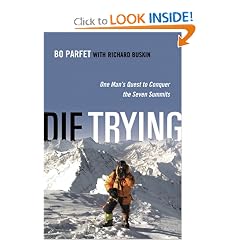
Book Review: Die Trying


In the world of mountaineering and adventure, the Seven Summits is one of the most sought after goals. In order to complete the challenge, a climber must successfully climb the tallest mountains on all seven continents. The list includes Kilimanjaro in Africa (19,340 feet), Aconcagua in South America (22,841 feet), Denali in North America (20,320 feet), Mt. Vinson in Antarctica (16,050 feet), Mt. Elbrus in Europe (18,442 feet), Carstensz Pyramid in Indonesia (16,024), Mount Kosciuszko in Australia (7,310 feet), and of course Mt. Everest in Asia, the tallest mountain on the planet at 29,029 feet. Sharp eyed readers will have already noted that that was eight mountains and not seven. When the original list was put together by Dick Bass, the first man to climb all of the Seven Summits, he included just the continental mountains, and thus Kosciuszko in Australia was on the list. Later, the list was amended by Reinhold Messner to to included all of "Oceania" which then added Carstensz Pyramid to the list. Most climbers do both just to cover their bases.

The Seven Summits are the the central theme for the book Die Trying by Bo Parfet and Richard Buskin, which was released earlier this year. The book follows Parfet's quest to climb each of those mountains, as he goes on a journey of self discovery along the way.

Parfet does a competent job of telling his own story, starting as a young man who struggled with a learning disability, but over came that to go on graduate college and get a lucrative job on Wall Street. But in the midst of working many long hours, while constantly eating takeout, and slowly getting out of shape, Parfet decided he needed to put a little excitement into his life. So, he planned a trip to Tanzania to make the trek up Kilimanjaro. While in college he had done some climbing, and caught the bug, but he had never been up as high as he was on Kili, and when he reached the summit, it gave him a sense of accomplishment that ended up changing his life.

From there, Bo decided that he would move on Aconcagua, which other climbers told him was a nice test to see if he could handle even higher altitudes. At that time, he wasn't even considering the Seven Summits, just going on a mountain adventure that would get him out away from his desk and out of his office. Parfet became creative with his approach, even using his corporate ties to do fund raising for a variety of charities that would help get him to the places he wanted to go climbing in. Not only was he getting to climb mountains, he was doing some good along the way too.

Eventually mountaineering began to become a more important part of his life, and by the time he left for Denali, his third peak in the Seven Summits, he was in better shape, carrying more appropriate equipment, and had experience level had risen dramatically. After topping out successfully on that mountain, which is often seen as a warm-up for Everest, he began to think about completing the Seven Summits in earnest.

Overall, I enjoyed Die Trying, as it is a good read to familiarize yourself with the mountains that make up the Seven Summits, and learn the basics of mountaineering. Parfet does a good job of describing the conditions that are faced on each of the Summits, and explains the various approaches to climbing each of them as well. He also mixes in plenty of his own personality, giving the story a more accessible, personal approach. He comes across as a likable guy that you wouldn't mind sharing a camp fire with, swapping stories into the night.

But make no mistake, this book isn't amongst the all time great mountaineering books. It is a fun, light read, and if you're looking for something new for your bookshelf, then by all means, give this one a go, just don't expect Into Thin Air or even Dick Bass' own Seven Summits, which I preferred to this book, although it is a bit dated now. For a fun adventure story though, you could do a lot worse.

Thursday, September 3, 2009

Jordan Romero Summits Carstensz Pyramid


I've written about Jordan Romero in the past. He's the 13-year old who is attempting to become the youngest person to complete the Seven Summits, and the latest entry on his blog indicates that he is now one step closer to that goal.

Jordan is currently in Indonesia where the word is that he has successfully reached the summit of Carstensz Pyramid, the tallest peak in Oceania. In the process, the teenager also managed to set a new record as the youngest person to complete that technical climb and reach the top of the 16,023 foot mountain. He now has just Mt. Vinson in Antarctica and Everest in Asia to complete the Seven Summits.

The current record for the youngest person to complete the Seven Summits is held by Johnny Strange, who finished his quest this past spring by topping out on Everest. Johnny is 17 years old, so obviously Jordan has a few years working in his favor to catch him. Despite that, his website says that he hopes to finish off the two remaining peaks within the next year, presumably going for Vinson in the December/January timeframe and then turning towards Everest in the spring.

The Seven Summits represent the highest mountains on the seven continents, and over the past 25 years or so have become one of the landmark achievements for outdoor adventure. The list has actually grown to include 8 mountains, as Mount Kosciuszko, the tallest point in Australia, has been supplanted with the much more challenging, and taller, Carstensz, but most of the Seven Summiteers do both, just to cover their bases. Besides those two, Vinson and Everest, the list includes the following: Mt. Elbrus (Europe), Denali (North America), Kilimanjaro (Africa), and Aconcagua (South America).

I know we recently had some discussion around here regarding Laura Dekker and her plans to sail solo around the world at the age of 13, and now we have another 13-year old who is planning on tackling Everest next year. The difference between these two is vast however, as Jordan won't be making his Everest attempt alone, and his father, who goes with him on every climb, happens to be a high altitude medical specialist. That said, I'll still say that Everest isn't the best place for a 13-year old kid. I know they'll use sound judgement in their approach, but much like Laura, I think it would be okay for them to wait a few years before making the attempt. After all, what is the hurry?
Related Posts Plugin for WordPress, Blogger...