Search This Blog

Showing posts with label Book Review. Show all posts

Thursday, August 11, 2011

Book Review: "Why God Won't Go Away" by Alister McGrath

Alister McGrath, Why God Won’t Go Away. Is the New Atheism Running on Empty? Thomas Nelson, 2010. Pbk. ISBN: 978-0-8499-4645-5. pp.191.

This book provides an overview and assessment of the “New Atheism” promoted by Sam Harris, Richard Dawkins, Daniel Dennett and Christopher Hitchens. After introducing its origins in the wake of the 9/11 attacks and the movement's major proponents, McGrath moves on to examine its claims and attraction. Part 2 focuses attention on the New Atheism’s three core themes and demonstrates how the movement fails to deal adequately with historical, philosophical and scientific challenges to its assertions. Finally, the author sums up the present state of the New Atheism which, and concludes that while it still continues to have some popular support (particularly on the Web), its intellectual drive seems to have run out of steam.

I found this a very helpful introduction to a movement of which I was before only dimly aware. McGrath applies his broad knowledge of history, science, theology and philosophy to test the claims of the New Atheism. Again and again the movement is demonstrated to be nothing more than hot air; an elitist group increasingly unpopular even amongst atheists. The movement has some appeal at the Sixth form debate level and excels at ridiculing religion, but has little or nothing new of substance to offer.

The one minor grumble I had with the book was on pages 67-68 where McGrath approvingly quotes Professor Robert Pape’s findings in order to demonstrate that the 9/11 attacks (and all other suicide attacks) were political rather religious in motivation. This really does not pass muster as in Islam it is not possible to separate religion and politics into two separate sources of motivation. The 9/11 attacks were therefore motivated by both religion and politics. This undermines McGrath’s argument somewhat at this point.

Apart from this one point I found Why God Won’t Go Away a helpful and enjoyable read and recommend to anyone engaging with the New Atheism, or studying the influence on the Internet on religious thought.

Disclosure of Material Connection: I received this book free from the publisher through the BookSneeze®.com book review bloggers program. I was not required to write a positive review. The opinions I have expressed are my own. I am disclosing this in accordance with the Federal Trade Commission’s 16 CFR, Part 255: “Guides Concerning the Use of Endorsements and Testimonials in Advertising.”

Monday, March 7, 2011

Book Review: Pink Boots and a Machete


If you're a regular reader of this blog, you've no doubt hear the name Dr. Mireya Mayor before. She is a host on Nat Geo Wild and was part of the team on Expedition Africa which aired on The History Channel back in 2009. The two-time Emmy Award-nominated television personalty is intelligent, personable, and adventurous, which come across on the screen in numerous ways. But if you only know the good doctor from her appearances on TV, you don't really know her at all. But her new book, which released last week, tells her amazing and inspiring tale, which took her from a sheltered childhood in Miami to some of the wildest places on the planet.

The book, entitled Pink Boots And A Machete: My Journey From NFL Cheerleader to  National Geographic Explorer, chronicles Mireya's journey beginning as a youth living in Little Havana who was told that she couldn't join the Girl Scouts because it was "too dangerous." A self described tomboy, even as a child, Mayor enjoyed learning about animals, playing with insects, and being outside. But she also had girlie side to her personality that liked to dress up, wear make-up, and chase boys. Her path through life led her to pursue acting and to joining the cheerleading squad of the Miami Dolphins, but it wasn't until she took an anthropology class late in her college career that she found her true calling. That class inspired her in ways that even she couldn't imagine, eventually earning her a PhD in Anthropology with a speciality in primates. Along the way, she also became a Fulbright Scholar, a National Science Foundation Fellow, and a National Geographic Explorer. Quite a resume for a girl whose mother wouldn't allow her to go camping, wouldn't you say?

In her autobiography, Mireya shares these stories and much more, and she does so in a style that comes across as very matter-of-fact. You get the sense that she is simply sharing her story and not trying to embellish it in any way. In this case, there is no need to embellish, as the story is one that is fun and fantastic all on its own. 

As the cheerleader-turned-adventurer grows in her ambitions and professional accomplishments, her journeys take her to the far corners of the globe. Throughout the book she shares tales of visits to the Congo, where she survives a terrifying plane crash, treks into the Lost World of Roriama in Venezuela, and Madagascar, where she discovered a new type of lemur. Along the way, she shares details on numerous encounters with wildlife, great and small, without ever losing her sense of humor and unwavering zest for life. 

The book is an excellent, inspiring read, and you'll be surprised at how quickly the 301 pages will pass. It moves along at a harrowing pace, and by the end, you'll still be wanting more. Thankfully, Dr. Mayor still has plenty of adventures ahead of her and we're likely to be reading about her exploits for years to come. 

Pink Boots is the kind of book that I would recommend to each of my five nieces, who are all nearing an age when they'll start to consider what they want to do with their lives. Mireya can serve as a great inspiration to young women everywhere, and while they may not end up trekking through jungle and climbing mountains, there is still a great message to be had about pursuing your dreams and letting adventure take you where it will. But this isn't a story just for the girls. We boys will find plenty to enjoy as well. The message is the same for us too, and Mireya's story still resonates just as effectively. 

The book is available in stores now, and is a great edition to any library. Excellent stuff. 

Wednesday, February 23, 2011

Book Review: Running Dry: A Journey From Source to Sea Down the Colorado River


As global climate change continues to change our planet in ways that we are still struggling to understand, one of the things that has become clear is that our conservation and usage of water is going to play a big role in our long term survival. Weather patterns are clearly changing, and as they do, once reliable sources of water are now struggling to keep up with the demands that we put on them. It seems that man has an unquenchable thirst for water and not just for drinking. We use it to irrigate our farms, water our lawns, clean ourselves and our possessions, and oh so much more. What effect is our usage, and climate change, having on our water supply? And what does it mean for our future?

That is the overriding theme of the book Running Dry: A Journey From Source to Sea Down the Colorado River by Jonathan Waterman. The book follows Waterman has he makes a spectacular 1450-mile journey along the length of the Colorado River, spending five months exploring those waters, while examining the effects of prolonged drought, climate change, and over usage by man on the river. What he found was an environmental catastrophe just waiting to happen, as the flow of the river is shrinking dramatically, leaving the lands surrounding it in desperate need of moisture.

Despite the fact that this is a book about water, it starts out awfully dry. Waterman spends the first chapter filling us in on the history of man's use of the river and explaining some of the complex issues that are facing how that usage is governed. It can be a bit of a slow way to start a book, but it pays off later when the actual adventure begins, as having that deep background helps us to understand and relate to what the author encounters once he starts his epic paddling journey.

That journey does become the core of the book however, and when Waterman begins to share his aquatic adventure with us, the story picks up quickly. Running a massive river like the Colorado is no small accomplishment, but he manages to do it and share tales of the people he met along the way and the things he saw in his weeks upon the river. Where Waterman excels in his writing is weaving those tales so deftly with the history and law of water rights management in the Western United States. He gives you just enough of both to keep you knowledgable about the important issues at hand while still enjoying a grand kayaking adventure at the same time.

Ultimately however this isn't an adventure book, but a call to action for those who live along the Colorado and beyond. The river is being altered dramatically, and in some ways irrevocably, and this book hammers that message home in some important ways. While the author remains hopeful that we can save the river, and there by save ourselves, the message is one of urgency, as precious time, and water, is slipping away.

Running Dry is an excellent read for environmentalists and paddlers alike. It is also an eye opener for those of us who were unaware of how several factors (climate change, drought, over usage) were conspiring to destroy one of the great natural wonders of the American West. Read it for the adventure but never lose sight of the overall message. You'll be glad you did on both accounts.

Wednesday, November 17, 2010

Book Review: The Summit

Climbing Mt. Everest, or any other big peak, is always fraught with perils. You have to deal with altitude and technical challenges. You'll have to acclimatize and plan your ascent carefully, and spend months preparing for an opportunity to reach the top that may never come, often due to circumstances beyond your control. How a climber deals with those challenges and adversities varies with each individual. For climber,  professional mountain guide, and author Eric Alexander, it is his religious faith that helps see him through those challenges.

That is the core premise behind Alexander's new book The Summit, which hits bookstores soon. The book is his opportunity to share not only his adventures in the mountains, but also how his faith in God served him well on those expeditions. In fact, those journeys actually helped to strengthen that faith and give him further insights into his beliefs.

On its surface, Alexander's story is a typical tale of adventure in the mountains. In the book he shares stories of his climbs on Ama Dablam, Kilimanjaro, Elbrus, Everest, and more. Those tales include near death experiences, crushing disappointments, spectacular triumphs. and moments of self discovery, aind in the author's case, moments of clarity about his faith.

The book begins with Alexander meeting and befriending Erik Weihenmayer, an experienced climber who also happens to be blind. The two men discovered that they were kindred spirits and soon they were climbing together all over the world. Their friendship would lead to the two of them going up Everest together, with Alexander serving as guide as Weihemayer climbed into history, becoming the first blind man to reach the summit of the tallest mountain on the planet. But the two climbers would go on to have even more adventures together.

For most arm chair mountaineers, Weihenmayer's story is well known, but in this case it is told from a different perspective, that of his guide, who helped him through some of his most challenging climbs. But Alexander also helped other physically challenged adventurers reach their goal, such as taking four blind teens to the top of Kilimanjaro and taking three "at risk" kids to the top of Mt. Pisco. Often times, Eric suffered and struggled himself to ensure that the people that he was guiding succeeded in their mission.

While The Summit does offer some interesting insights into the various climbs, I personally found little new in the book. If you've already read some of the more well known mountaineering books, you probably won't feel that you've garnered much new out of this book. The most interesting story for me personally was the climb up Everest with blind mountaineer Weihenmayer, but you'll likely find his own book, Touch the Top of the World, a better read. Don't get me wrong, The Summit isn't a terrible book, although I did find the writing to be a bit uneven at times.

Perhaps part of my issue with the book was Alexander's focus on his faith. Now, admittedly, that is one of the central messages of the book and at the core of the story that the author is telling. While I am personally not a religious person, I do have a spiritual side, and a healthy respect for other people's religious beliefs. That is why when Alexander refuses to take part in in certain cultural rituals in Nepal, such as spinning prayer wheels, on the basis that they are essentially pagan rituals, I couldn't help but feel a bit of a disconnect. While I respect Eric's religious views, I couldn't relate to the way he saw some of the beliefs of others.

That aside, The Summit is a solid entry into the mountaineering book club. For armchair mountaineers who are looking for something new to read, the book will keep you entertained, and if you're a Christian who takes their faith very seriously, the religious aspects will appeal as well. If you're new to the genere however, there are plenty of other books I'd recommend ahead of this one.


Tuesday, August 24, 2010

Book Review: The Heresy of Orthodoxy by Andreas J. Köstenberger & Michael J. Kruger

Andreas J. Köstenberger and Michael J. Kruger, The Heresy of Orthodoxy. How Contemporary Cultures Fascination with Diversity Has Reshaped Our Understanding of Early Christianity.  Leicester: Apollos, 2010. Pbk. ISBN-13: 978-1-84474-446-6. pp.250.

This is a timely work for those wishing to answer the stream of recent books and articles arguing that we cannot know what the first followers of Jesus actually believed. What we can be sure of - writers such as Bart Ehrman assure us - is that the Church in the third and fourth centuries imposed is own interpretation of Jesus and suppressed the earlier "original" Christianity - which is now lost forever. As fictional as this interpretation of history might be it does require a considerable amount of time and effort to refute. I for one and very grateful for Köstenberger & Kruger for doing so in this volume.

The book is divided into three sections, answering in turn the three assertions of the Bauer-Ehrman hypothesis. Section 1 asks what is the evidence for a plurality of "Christianities" vying for supremacy in the early church. Drawing on some superb recent research by Richard Bauckham (Jesus and the Eyewitnesses), Larry Hurtado (Lord Jesus Christ: Devotion to Jesus in Earliest Christianity - now sadly out of print) and others, the authors make a convincing case that there was substantial and very early unity in the church about central issues of faith. Section 2 answers the issues of whether the later church decided which books were canonical in order to exclude "true Christianity" from the church. It demonstrates that the concept of "canon" is found within the New Testament itself and that even before the NT was complete parts of it were being recognised by apostolic witnesses as being of equal or greater authority than the Old Testament scriptures. Although a small number of books were still disputed until fairly late on, the core of the NT was very quickly accepted as Scripture. The third and fourth century church did not therefore invent the canon, they simply listed those books that had already been recognised as being authoritative.

The third and final section turns to the subject of textual criticism and focuses quite narrowly on how texts were copied in the ancient world and whether it was possible for a theological change made by a scribe could have become universally accepted without modern textual critics being able to identify it. Because of the vast number of NT manuscripts available and the speed in which they were disseminated throught the Empire we now know that this sort of theological change would have been impossible.

This book would prove a valuable addition to the library of anyone involved in apologetics today and anyone starting a theology course this Autumn. Some knowledge of early church history would be helpful, but not essential, as the authors do their best to explain who the characters they discuss are. It is a masterpiece of summarisation and deserves a wide readership.

I would like to leave the last word to D.A. Carson, who writes on the back cover:
In the beginning was Diversity. And the Diversity was with God, and the Diversity was God. Without Diversity was nothing made that has been made. And it came to pass that nasty old 'orthodox' people narrowed down diversity and finally squeezed it out, dismissing it as heresy. But in the fullness of time (which is of course our time). Diversity rose up and smote orthodoxy hip and thigh. Now, praise be, the only heresy is orthodoxy...

Wednesday, July 14, 2010

Let Go and Let God by Andrew Naselli

I love reading Ph.D. Theses and so I was delighted when Andy Naselli sent me a copy of his to review. Naselli's thesis - Let Go and Let God - is a historical and theological analysis / critique of the theology of the Early Keswick movement. For those who are not familiar with this - and I include myself in that number before reading this book - it involves the belief that the work of sanctification in the believer is wholly the work of God  which requires a "second blessing" baptism in the Spirit. This Second Blessing transforms the believer from a "carnal" to a "spiritual" Christian. Although I was unfamiliar with the movement I did recognise many of the names of those who propagated Keswick theology and have read their books. Naselli's historical section very helpfully demonstrates how Keswick teaching was worked out in their lives and ministries - not always with positive results. The theological analysis / critique of the movement is concise and telling, demonstrating that early Keswick's teaching on holiness was based first on experience and then on faulty exegesis which attempted to support that experience. The Keswick Movement - which continues to this day - stands apart from its early forebears and no longer holds to this teaching, yet early Keswick's influence continues to make itself felt.

With around 30 pages of endorsements in its introduction I feel that I can add little more, except to commend it to any thinking Christian who wants to understand more clearly the New Testament teaching on holiness / sanctification. You can read some sample pages here. The book is due to be published in electronic form by Logos (details here). I hope that a printed version will also appear in due course - I will certainly be adding it to my library.

Friday, April 30, 2010

Book Review: Oceans: The Threats to Our Seas and What You Can Do to Turn the Tide


Last week, in celebration of Earth Day, Disney and National Geographic released a ground breaking new film called Oceans. Directed by Jacques Perrin, the visionary filmmaker who brought us the acclaimed nature films Microcosmos and Winged Migration. Oceans has been years in planning and production, and by all accounts, it is stunning to behold on the big screen. I say this, because as of this writing, I have yet to see the film, due to the fact that I couldn't find a cineplex in Kathmandu.

On the other hand, while traveling abroad I did have the opportunity to read Oceans: The Threats to Our Seas and What You Can Do to Turn the Tide. The book, which is edited by Jon Bowermaster, is meant to serve as a companion of sorts to the film. It is a compilation of 31 different essays from as many authors, on a number of different topics centered around our seas, and the threats to their health, which will have wide ranging consequences for the future of the entire planet.

Some of the essays are sentimental in nature, such as Carl Safina's "Caught in the Same Net" and "Remembering the Ocean" by Celine Cousteau. Others offer up warnings about the Oceans' future, such as "Coral Reefs in Crisis", written by Abigail Alling or Richard Ellis' "The Bluefin's Uncertain Future". All of the stories are informative, insightful, and fascinating, especially if you have any level of awareness about the impact of global climate change. Other authors contributing to the book include ocean explorer Sylvia Earle, circumnavigator Liz Clarke, Captain of the Plastiki David de Rothchild, and Adventure Blog favorite Roz Savage. Even actor Leonardo DiCaprio submitted a short piece on how important, yet finite, a resource our water supply is. Bowermaster's own contribution, an essay on the changing state of the ice around Antarctica is also a sobering story about what is happening now, and how it could impact the future.

Whether you've seen the new film or not, Oceans makes for engrossing reading. But if you have seen the film, the book opens with an interview with director Perrin, who discusses what it was like to get this film made. It was a huge undertaking, involving camera crews visiting 54 locations around the globe, and on one particular day there were 26 location managers and 19 cameras in the field. A host of new technology was also created for the movie, including specially modified underwater cameras, a remotely controlled helicopter camera, and even a torpedo cam. Fascinating stuff to be sure, and something that will no doubt be on my mind when I get a chance to watch the movie itself.

So, whether you've seen the movie or not, be sure to grab a copy of this book. It is a great compilation of insights and thoughts on our oceans from some of the foremost experts on the topic.

Thursday, November 12, 2009

The Ten Best Adventure Biographies (According to Outside)


Outside Magazine has posted a new article that lists their choices for the 10 Greatest Adventure Biographies of all time. The list is made up of a host of big name explorers and adventurers who left their mark in a variety of ways.

For anyone looking to fill out their bookshelf, there are some outstanding books on this list. For instance, Outside gives kudos to The Wildest Dream by Peter & Leni Gillman, the biography of George Mallory, who famously disappeared on Everest at the age of 37 back in 1924. But prior to being lost in the Himalaya (only to be found in 1999), Mallory built a reputation as one of the best high altitude climbers in the world, honing his skills in the Alps, before heading to Asia as part of British exploratory teams.

Shackleton by Roland Huntford also makes the list, detailing the life of polar explorer Ernest Shackleton, best known for his expeditions to the Antarctica aboard the famous ship the Endurance. Huntford gives a more complete picture of the man than just those epic tales of adventure however, showing a very flawed and complex character.

Other people whose biographies earned a spot in the top ten include African explorer Henry Morton Stanley, co-first summiteer of Everest Tenzing Norgay, and everyone's favorite outdoor schizophrenic Chris McCandless. There are obviously others as well, and I won't spoil all the fun in finding out who they are. But be prepared to have Amazon open in another browser window, you'll want to add these great books to your library as soon as possible.

So did they leave any great biographies off the list? With only ten to choose from, it must have been difficult to narrow it down. What's your favorite and why should it have been added?

Tuesday, October 13, 2009

Book Review: K2: Life and Death on the World's Most Dangerous Mountain


It is known as the "mountaineer's mountain", and unlike the taller, but technically less challenging Everest, it remains off limits for all but the most talented and dedicated of climbers. It is K2, the second highest mountain on Earth, but arguably the most deadly. It also happens to be the subject of a new book by Ed Viesturs which hits bookstores today, entitled K2: Life and Death on the World's Most Dangerous Mountain.

While the general public remains fixated on Everest, K2 seems to epitomizes the dangers of high altitude climbing unlike any other mountain. For the mountaineering community, both armchair and actual, it is a mountain of mythical proportions, both literally and figuratively. Located in the Karakorum range of Pakistan, K2 stands 28,251 feet in height, some 778 feet shorter than Everest. Despite this difference in height however, K2 remains orders of magnitude more challenging to climb than the Himalayan giant.

Few people know this better than Viesturs, who has climbed both mountains. In fact, Ed is the only American to have reached the summit of all 14 of the 8000 meter peaks, accomplishing this feat without the use of supplemental oxygen. Ed's quest to complete that task was chronicled in his earlier book No Shortcuts To The Top, in which he gave insights into his climb on K2, which was quite possibly the most dangerous climb ever.

Despite the fact that K2 played a prominent role in his first book, Ed still had more to share about his experience on that mountain, and that is at the core of this new book, although it isn't the sole focus. Viesturs says that he learned the most important lesson of his career on K2 when he pressed on to the summit despite terrible weather, when every instinct was telling him to turn back. With conditions worsening, he reached his goal, and turned back down the mountain, knowing full well that many climbers have died on K2 while descending the mountain, and although he lived to climb another day, he promised himself that he would never ignore his instincts again. That lesson would serve him well on future climbs, including several on Annapurna.

As I said earlier, Viestur's K2 climb isn't the only focus of this new book however. He also takes a look at some of the most important historical expeditions to the mountain as well, recounting a number of the legendary tales from the legendary mountain. Some of the other expeditions that Ed shares with readers include the 1938 team, led by Charlie Houston, that paved the way for eventual summit success in 1954. Houston's ill fated 1953 expedition also receives plenty of attention as well, as it gave us one of the most enduring mountain stories in "The Belay", and of course the 2008 season is also examined as one of the most tragic climbs in the history of mountaineering.

Anyone who has read No Shortcuts knows what to expect out of Veistur's writing style. Ed is once again assisted by co-author David Roberts, and their collaboration once again results in a book that is easy and fun to read. At times, it is almost as if you're sitting around the fire with Ed himself, sharing tales of high adventure in the Karakorum, which turns K2 into quite the page turner, especially when reading about the historical expeditions, where you know the gear and apparel were not up to the standards of today, and climbers suffered mightily while high on the mountain.

For fans of Ed or mountaineering in general, picking up this book is a no brainer. It is a very quick read that serves as a perfect introduction to K2 and the lore that surround the mountain. If you've read a lot of other books on the subject, there isn't a ton new here, although it is interesting to get Viesturs' insights on the history of the peak. Personally, I'd still recommend the classic Savage Mountain as the preeminent book on K2, but this book is a worthy heir to that throne, and an excellent read in its own right.

Monday, September 21, 2009

Book Review: The New Age of Adventure


When it comes to covering the world of adventure, there are few, if any, publications that are as comprehensive and authoratative as National Geographic Adventure, which is currently ten years of amazing writing. In that first decade of its publication, Adventure has covered everything from climbing the world's highest peaks to sailing the oceans and exploring remote jungles, along with much much more. Many of the stories published in the magazine have garnered praise and won awards that go well beyond the adventure community, and the magazine has earned a reputation for top notch journalism.

To further celebrate this first decade of publication, a new books has just hit store shelves entitled The New Age of Adventure. The book compiles some of the very best articles that have graced the pages of Adventure over the past ten years, with such authors as Sebastian Junger, Laurence Gonzales, Peter Matthiessen, Jon Bowermaster and many more.

The book opens with an excellent introduction by John Rasmus, who is the founding editor of Adventure. In this intro, Rasmus looks back at the early days of the magazine, and some of the first stories that they published, as we closed out the 20th Century. He says that we are witnessing a change from an age of exploration to a new age, one of conversation. It is from this changing focus that the book gets its title. Rasmus explains that there are fewer "blank spots" on the map now, and we understand that our planet needs to be preserved and protected, and that is where we're headed in this new century.

Following the introduction, we're on to the stories. 25 of them in fact. These articles span the globe from Afghanistan to the Sahara, on to Alaska, and beyond. The stories range in scope to epic stories of adventure to intimate portraits of the adventurers themselves. The articles are just as engrossing now as they were when they were first published, and a number of them have a brief follow-up at the end to give us a bit of insight as to how things may have changed sine they first appeared in the magazine.

It is difficult to single out any one or two of the articles from the others, as they are all fantastic. As I read the book, I often caught myself falling pray to "just one more" syndrome. As in "I'll read just one more story before calling it a night." I can only imagine how difficult it was to sift through all the back issues of Adventure and narrow down all the great stories to just these 25. But the ones we do get are all of superior quality and they will each leave a lasting impression on you.

Personally, I found Tim Cahill's "The Lure of Impossible Places" to be quite excellent, as it really captured the spirit of adventure and exploration. David Robert's "Out of Thin Air" was also quite interesting as well, chronicling the expedition to Everest that discovered the remains of Mallory. And Philip Caputo's "Among the Man-Eaters" remains a fascinating piece on the lion prides of Kenya nearly ten years since it was first published.

I could go on and on about the outstanding writing and great stories, but you get the picture. Let me make this easy for you. If you're a fan of National Geographic Adventure magazine, you owe it to yourself to pick up this book. In some ways it is a bit of a walk down memory lane, and in others it is a reminder of why we love adventure and exploration in all of its forms. While reading this book you'll be inspired, humbled, and fascinated with each page you turn, which is exactly what Adventure has been doing for ten years. Congrats on the first decade, here's to many more to come!

Friday, September 18, 2009

Best Books To Have in Your Backpack


Here's an interesting list from a website called Bookride, which has compiled their selection of Backpacker Classics, or the best books to have in your pack when you're out on the trail.

There are indeed some classic books of both fiction and non-fiction on their list. Things like On the Road by Jack Kerouac and Snow Leopard by Peter Mathiessen, both of which are well known adventure classics. Other popular works, such as One Flew Over the Cuckoo's Nest and Milton's Paradise Lost earn a spot too, and the rest of the books are equally diverse and eclectic.

When defining what makes a good "backpacker classic" Bookride says they "should have an element of profundity, preferably mystical -if not it should have cult status or be a statement about who you really are." Personally, I look for something entertaining, and in paperback form. Hardbacks taking up space and adding weight aren't a lot of fun for your pack. But all in all, this is a good list that is difficult to argue with. Lots of classic books. But I have to argue with the inclusion of Catcher in the Rye, J.D. Salinger's seminal novel. No one outside of a high school classroom should subject themselves to that one. ;)

Fun list. What did they miss? The one that stands out most to me is Into Thin Air. Thanks to Gregory Goes There, the official blog of Gregory Packs, for the link!

Friday, September 11, 2009

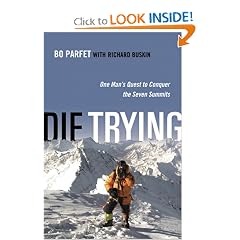
Book Review: Die Trying


In the world of mountaineering and adventure, the Seven Summits is one of the most sought after goals. In order to complete the challenge, a climber must successfully climb the tallest mountains on all seven continents. The list includes Kilimanjaro in Africa (19,340 feet), Aconcagua in South America (22,841 feet), Denali in North America (20,320 feet), Mt. Vinson in Antarctica (16,050 feet), Mt. Elbrus in Europe (18,442 feet), Carstensz Pyramid in Indonesia (16,024), Mount Kosciuszko in Australia (7,310 feet), and of course Mt. Everest in Asia, the tallest mountain on the planet at 29,029 feet. Sharp eyed readers will have already noted that that was eight mountains and not seven. When the original list was put together by Dick Bass, the first man to climb all of the Seven Summits, he included just the continental mountains, and thus Kosciuszko in Australia was on the list. Later, the list was amended by Reinhold Messner to to included all of "Oceania" which then added Carstensz Pyramid to the list. Most climbers do both just to cover their bases.

The Seven Summits are the the central theme for the book Die Trying by Bo Parfet and Richard Buskin, which was released earlier this year. The book follows Parfet's quest to climb each of those mountains, as he goes on a journey of self discovery along the way.

Parfet does a competent job of telling his own story, starting as a young man who struggled with a learning disability, but over came that to go on graduate college and get a lucrative job on Wall Street. But in the midst of working many long hours, while constantly eating takeout, and slowly getting out of shape, Parfet decided he needed to put a little excitement into his life. So, he planned a trip to Tanzania to make the trek up Kilimanjaro. While in college he had done some climbing, and caught the bug, but he had never been up as high as he was on Kili, and when he reached the summit, it gave him a sense of accomplishment that ended up changing his life.

From there, Bo decided that he would move on Aconcagua, which other climbers told him was a nice test to see if he could handle even higher altitudes. At that time, he wasn't even considering the Seven Summits, just going on a mountain adventure that would get him out away from his desk and out of his office. Parfet became creative with his approach, even using his corporate ties to do fund raising for a variety of charities that would help get him to the places he wanted to go climbing in. Not only was he getting to climb mountains, he was doing some good along the way too.

Eventually mountaineering began to become a more important part of his life, and by the time he left for Denali, his third peak in the Seven Summits, he was in better shape, carrying more appropriate equipment, and had experience level had risen dramatically. After topping out successfully on that mountain, which is often seen as a warm-up for Everest, he began to think about completing the Seven Summits in earnest.

Overall, I enjoyed Die Trying, as it is a good read to familiarize yourself with the mountains that make up the Seven Summits, and learn the basics of mountaineering. Parfet does a good job of describing the conditions that are faced on each of the Summits, and explains the various approaches to climbing each of them as well. He also mixes in plenty of his own personality, giving the story a more accessible, personal approach. He comes across as a likable guy that you wouldn't mind sharing a camp fire with, swapping stories into the night.

But make no mistake, this book isn't amongst the all time great mountaineering books. It is a fun, light read, and if you're looking for something new for your bookshelf, then by all means, give this one a go, just don't expect Into Thin Air or even Dick Bass' own Seven Summits, which I preferred to this book, although it is a bit dated now. For a fun adventure story though, you could do a lot worse.

Wednesday, September 9, 2009

Adventure Checks Out Viestur's New Book


National Geographic Adventure got the opportunity to check out Ed Viestur's new book, K2: Life and Death on the World’s Most Dangerous Mountain, and have posted some thoughts on their Adventure Blog. As you can surmise from the title, the book focuses on climbing K2, and the particular skills and mindset needed to summit that especially dangerous mountain.

Viestur's has climbed K2, and in the book he shares his thoughts, as well as those of other mountaineers, on the challenges of making the climb. Evidently, he also shares his favorite stories from the mountain as well, including his insights on the legendary and fateful expedition that was chronicled in Savage Mountain led by Charles Houston.

The book is not scheduled to be released until October 13th, and I haven't received a copy of it yet, but I'm looking forward to reading it when I get the chance. I enjoyed Viestur's first book, No Shortcuts To The Top, very much, and suspect that I'll enjoy this one too. The book seems particularly timely following last year's tragedy, and the fact that teams struggled mightily on K2 again this year. Keep an eye out for this one in a month's time.

Thursday, May 28, 2009

NIV Archaeological Study Bible – A Review

Ever since I first read the archaeological supplement in my Thompson Chain Reference Bible I have found the subject of Biblical archaeology fascinating. For that reason I was delighted when Zondervan sent me a copy of the NIV Archaeological Study Bible to review.

The main feature of the Archaeological Study Bible is the inclusion of 500 articles of various lengths (200 words). These are placed under several thematic headings:

Ancient Peoples, Lands and Rulers

These include “The Location of Eden,” “Josiah, Zechariah and Neco II,” “The Annals of Sargon II,” “Babylon,” “Antiochus IV Epiphanes,”

Archaeological Sites

These include: “Beth Shemesh,” “Sheba,” “Hezekiah’s Tunnel,” “Gezer,” "Byblos,” “Thebes,” “Adullam,” “The Pool of Siloam,” “Masada,” “Crete,”

Ancient Texts and Artifacts

These include: “Ancient Creation Narratives,” “The Sumerian King List,” “Ugaritic Liturgy Against Venomous Snakes,” “The Teaching of Amenemope,” “the Apocrypha,”

The Reliability of the Bible

The include: “The Documentary Hypothesis,” “Alternative Theories About The Exodus,” “The Chronology of Ezra and Nehemiah,” “The Canonicity of Esther,” “The Problem of the Septuagint Version of Jeremiah,” “The Unity of Amos,”

Cultural and Historical Notes

These include: “The Golden Calf,” “"The Jewish Calendar,” “The Judges Period,” “Dagon,” “Siege Warfare,” “Idols and Idol Making,” “Baptism in the Ancient World,”

Ancient Voices

Short quotations of ANE writings showing a parallel theme to the passage next to which they are placed.

There are also some helpful charts, a glossary of terms used and the usual complement of maps.

I have to say that despite reading some of the negative reviews of this Bible on-line, I thought that the notes were generally helpful and balanced. They take a conservative view in most cases, presenting the argument well for an early Exodus, the unity of Isaiah and a 7th Century date for the composition of the Book of Daniel. There are obvious difficulties involved in reducing these complex arguments to a 200 word summary, but in most cases this has been achieved while still admitting the possibility of a different interpretation of the evidence. I say in most cases, because the notes take a strongly egalitarian view of the gender passages in the New Testament and do not admit any possibility that this might be not what the archaeological evidence points too, or indeed, that there is any other way of viewing the passages at all!

One of my favourite notes is found on page 1594: "The Legend of the Needle's Eye Gate". It correctly argues that the existence of a 'Needle's Eye Gate' in the wall of Jerusalem is based not on archaeology, but on a medieval legend. Far from illuminating one of Jesus' "Hard Sayings" the legend of the Needle's Eye Gate actually weakens its meaning. Preachers, take note!

So, on the whole, I would recommend this Bible to anyone with an interest in archaeology, as long as they use it to whet their appetite for other more detailed works on the subject. One final caveat: unless you are younger than me or have exceptionally good eyesight I would not recommend the use of the "Personal Size" Version without access to a strong magnifying glass!

Saturday, December 6, 2008

Book Review: The Chronological Study Bible


I can look back at my early days as a Christian and identify a number of books that helped me to gain an understanding of the Bible. The year I spent going through the Bible chronologically using a set of study notes from CWR helped me to understand the order of the events described in the Bible. Likewise F.F. Bruce’s book Israel and the Nations gave me an understanding of how the events in the land of Israel related to those in the wider context of the Ancient Near East. Because these two books were so influential on me I was delighted when Thomas Nelson Publishers offered me a chance to review their new Chronological Study Bible as it combines the benefits of both of these approaches.

The introduction states the purpose of this book:

The Bible was not written at one time nor by one author. The books of the Old and New Testaments were written over a period of more than 1,000 years, and their contents cover a variety of ancient peoples and cultures. If we are to understand and appropri­ate the Bible's message today, we need some sense of the historical and cultural context in which its di­verse parts appeared. We read the words of the Bible today under entirely different circumstances than those under which they were written. To ne­glect the historical and cultural background of the biblical books is to risk misunderstanding them.


Unfortunately for modern readers, the individ­ual books of the Bible do not always provide the in­formation necessary to understand the Bible's his­torical and cultural background. At the time that these books were written, readers would have al­ready been familiar with the world the writings de­scribe. But thousands of years later, the events and customs that the original readers would have recog­nized immediately are often confusing and only dimly understood by modern readers.


The Chronological Study Bible will take you on a journey through the history and culture of the Bible. It will allow you to step back into biblical times and discover the world out of which the Bible grew. It will help you follow the flow of events in the Scriptures and see where sacred and secular history converge into one story of salvation. You will learn how sacred history fits into the context of secular history—why an event happened, how events relate to each other, as well as the cultural, religious, political, and geographical background that influenced the events.

In order to achieve this the entire text of the Chronological Study Bible is arranged in the order in which it is thought the historical events occurred. So when one comes to the Books of 1 & 2 Samuel, 1 & 2 Kings and 1 & 2 Chronicles, the Psalms of David and the writings of the various prophetic books are placed at the appropriate points in the account. The Wisdom Literature is placed in the lifetime of Solomon because of its probable date of composition (although Job is set in Patriarchal times and some of the Proverbs date from the time of Hezekiah by their own ascriptions). Likewise in the Gospels, in a similar way to any good Gospel synopsis, the events of Jesus’ life and ministry are rearranged and in the Book of Acts, the New Testament letters are inserted.

As the Introduction recognizes there is disagreement in the exact dating and order of a number of Biblical books and events and the various options are presented to reflect this. As anyone who has compared the various Synopses of the Gospels available will know there are a number of ways of arranging events in the life of Jesus as the exact timing was not always the writer’s concern.

A number of other features are included. Numerous timelines and charts relate the biblical events with those in the surrounding nations. Archaeological discoveries such as the Black Obelisk of Shalmaneser III and the Moabite stone are pictured and their significance to the Biblical text explained.

A couple of problems should be noted that may be corrected in later editions. The map on page 46 "Jacob Returns to Canaan" seems to have been erroneously copied from page 237 ("The Conquest of Canaan"). Other maps are not as clear as they could be. For example the map on page 73 showing the possible routes of the exodus contains no key to explain the various coloured lines.

Despite these minor flaws I am sure that this Study Bible will be of great help to a wide range of Bible readers, from new Christians to experienced Bible teachers. Fellow homeschoolers, for example, would find it useful when used in conjunction with Susan Wise Bauer‘s History of the World or any other course approaching world history chronologically. Such is the breadth of the study of Biblical history and background brought together in this volume that any reader is bound to gain some fresh insight and be able to use this to enrich their own study with their usual canonically ordered Bible.

[Thanks to Patricia Flynn for her keen eye for detail].

Related Posts Plugin for WordPress, Blogger...