At the moment, the U.S., like most of the world, is embroiled in an economic malaise. The country is dealing with high unemployment rates, a shaky housing market, and federal budget crisis that threatens to make matters even worse. Because of this situation, many people have been saying that we need to cut NASA's budget even further and concentrate on fixing problems here on planet Earth. Astronomer Neil deGrasse Tyson has an answer to those people in the video below, in which he tells us exactly why we need NASA, both now and in the future. It's a great message about exploration, technology, and inspiring a whole new generation that seems fitting at the moment.
Showing posts with label Space. Show all posts
Showing posts with label Space. Show all posts
Tuesday, July 26, 2011
Why We Need NASA
Last week, the Space Shuttle Atlantis touched down for the final time, effectively bringing an end to America's manned space program – at least for now. For many of us, this was truly the end of an era, and with no clear cut plans for a replacement program, it seems like space exploration has been put on the back burner.
At the moment, the U.S., like most of the world, is embroiled in an economic malaise. The country is dealing with high unemployment rates, a shaky housing market, and federal budget crisis that threatens to make matters even worse. Because of this situation, many people have been saying that we need to cut NASA's budget even further and concentrate on fixing problems here on planet Earth. Astronomer Neil deGrasse Tyson has an answer to those people in the video below, in which he tells us exactly why we need NASA, both now and in the future. It's a great message about exploration, technology, and inspiring a whole new generation that seems fitting at the moment.
At the moment, the U.S., like most of the world, is embroiled in an economic malaise. The country is dealing with high unemployment rates, a shaky housing market, and federal budget crisis that threatens to make matters even worse. Because of this situation, many people have been saying that we need to cut NASA's budget even further and concentrate on fixing problems here on planet Earth. Astronomer Neil deGrasse Tyson has an answer to those people in the video below, in which he tells us exactly why we need NASA, both now and in the future. It's a great message about exploration, technology, and inspiring a whole new generation that seems fitting at the moment.
Thursday, July 21, 2011
The Space Shuttle Lands For The Final TIme
At 5:56 AM ET, the Space Shuttle Atlantis touched down at Kennedy Space Center for the final time, bringing to a close the shuttle era. The video below shows that final landing, and although it is a little on the dark side, you can still catch history in the making. It could be my imagination, but it seems that even the announcer is a bit choked up.
I have been fortunate enough to visit the Kennedy Space Center and see the shuttle on the launch pad in all of its glory. A few days later, I was luck enough to witness a night launch as well. For most of my life, the Space Shuttle has represented exploration and a quest for knowledge, and I'm sad to see it go. Lets hope the next era of space travel isn't as far off as it seems at the moment.
I have been fortunate enough to visit the Kennedy Space Center and see the shuttle on the launch pad in all of its glory. A few days later, I was luck enough to witness a night launch as well. For most of my life, the Space Shuttle has represented exploration and a quest for knowledge, and I'm sad to see it go. Lets hope the next era of space travel isn't as far off as it seems at the moment.
Friday, July 8, 2011
National Geographic Commemorates The Final Space Shuttle Mission
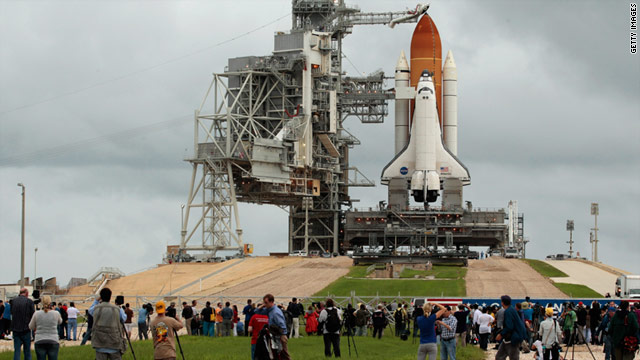
The Space Shuttle Atlantis is scheduled to blast off this morning, weather permitting, on the last shuttle mission ever. To celebrate, and commemorate, the end of an era in space exploration, National Geographic has updated their Space Shuttle Hub Page with images and videos from the 30-year history of the shuttle program. And once the mission is officially underway, the site will also feature ongoing blog posts from Nat Geo's space editor Victoria Jaggard.
The site already has a ton of great information in place, including a look at the shuttle program's place in history, five myths about the Challenger, and videos of the shuttle's final days. If you're a fan of NASA and the Space Shuttle, you'll really enjoy the site, and want to return regularly for updates during the final mission.
When Atlantis finally returns to Earth after completing this mission, it will truly mark the end of an era. The shuttle has been a workhorse for three decades, delivering both astronauts and payloads into orbit. The International Space Station, which will continue the mission to explore space, wouldn't exist without the shuttle, and it's retirement from active duty leaves a large hole in America's space program. While I've come to grips with the fact that it is time to put the shuttle out to pasture, that doesn't mean I'm not going to miss it. The fact that a viable replacement is at least three or four years away, doesn't help matters either.
Godspeed old friend. You will be missed!
Wednesday, May 25, 2011
NASA Unveils Next Generation Space Vehicle

With just one space shuttle mission still on the docket, the current U.S. space program is quickly coming to an end, and soon the venerable workhorse shuttle will be put in mothballs and sent to museums. Until today, it was unclear as to where NASA would go with its next generation space vehicle, but earlier they announced a new system that will carry astronauts back into orbit, and beyond.
The new craft is dubbed the Multi-Purpose Crew Vehicle (MPCV) and it springs from a design that originated at Lockheed Martin. That aerospace company created the Orion Crew Exploration Vehicle, which puts a small capsule, not unlike the Apollo spacecraft that pre-date the shuttle, inside a multifunctional system that is built to put man in space in a far safer, and cheaper, manner than we currently are capable of.
The MPCV offers room for four crew members, down from the eight that were possible on the shuttle. It also lacks the shuttle's giant cargo bay, which means satellites and sections of the International Space Station will have to be delivered by other means. The crew can live aboard the MPCV for up to 21 days, inside its 316 cubic-foot cabin. There is room aboard for small projects and experiments, but otherwise, it'll be a rather cramped living quarters.
The new system is lauded for the fact that it suppose to be ten times safer than the current shuttle launch vehicle, which seems likely considering the issues that NASA has had in that regard. It also expected to be far less expensive to operate as well. But what has most space enthusiasts excited is that the MPCV can leave low orbit, something the shuttle wasn't capable of, and climb further out into the reaches of space, perhaps even to the moon at some point.
To read more about NASA's new project, click here.
Wednesday, March 9, 2011
The End Of An Era: Shuttle Discovery Flies For The Last Time
It was a historic day, and the end of an era, earlier when the Space Shuttle Discovery touched down for the final time. This is the last of the scheduled space shuttle missions, and effectively brings an end to America's space program, at least for the foreseeable future.
Discovery landed back at Kennedy Space Center after making one last journey to the International Space Station to deliver supplies and provide maintenance to the ISS. Upon landing, the odometer on the shuttle reads 148 million miles and 365 days in orbit. Over 27 years of service, the Discovery was a workhorse indeed. The next stop for the Discovery is the Smithsonian National Air and Space Museum.
As I've mentioned earlier, I'm a bit sad that the shuttle program has come to an end. While the craft have gotten outdated over the years, they're still the best spacecraft that man has ever built. We're also years away from a true replacement and I hate the thought of a generation of astronauts grounded and waiting for their next flight. Lets hope that next flight comes sooner than later, but we've got years of design and testing to go through before we see anything close to the space shuttle again.
Here's to one last salute for the Discovery, the entire space shuttle program, and the astronauts that traveled in her. Lets not forget the men and women on the ground who made it all possible.
Discovery landed back at Kennedy Space Center after making one last journey to the International Space Station to deliver supplies and provide maintenance to the ISS. Upon landing, the odometer on the shuttle reads 148 million miles and 365 days in orbit. Over 27 years of service, the Discovery was a workhorse indeed. The next stop for the Discovery is the Smithsonian National Air and Space Museum.
As I've mentioned earlier, I'm a bit sad that the shuttle program has come to an end. While the craft have gotten outdated over the years, they're still the best spacecraft that man has ever built. We're also years away from a true replacement and I hate the thought of a generation of astronauts grounded and waiting for their next flight. Lets hope that next flight comes sooner than later, but we've got years of design and testing to go through before we see anything close to the space shuttle again.
Here's to one last salute for the Discovery, the entire space shuttle program, and the astronauts that traveled in her. Lets not forget the men and women on the ground who made it all possible.
Thursday, February 24, 2011
132 Space Shuttle Launches In 132 Seconds
Later today the Space Shuttle Discovery is scheduled to make its final launch before the shuttle program is mothballed by NASA. In honor of that historic event, CNN.com has put together his great video which shows all 132 shuttle launches in just 132 seconds. You can also read their story on the event by clicking here.
The space shuttle has been a pivotal part of space exploration not just for the U.S., but for the entire world, for years, and I'm a bit sad to see it come to an end. NASA is busy working on a replacement program, but in these tough economic times it is a difficult sell to say the least. A new shuttle will probably cost in the hundreds of millions of dollars at the very least, and at this point it is years from becoming a reality. While the International Space Station will continue to serve as a platform for research going forward, I can't help but think that we have taken a step back in this area simply by not having a replacement for the shuttle already in the pipeline. Lets hope it isn't too long before we get back to reaching for the stars. After all, there is an awful lot of stuff out there that we don't know about, and I for one believe that we can understand a lot more about ourselves by learning more about the Universe around us.
The space shuttle has been a pivotal part of space exploration not just for the U.S., but for the entire world, for years, and I'm a bit sad to see it come to an end. NASA is busy working on a replacement program, but in these tough economic times it is a difficult sell to say the least. A new shuttle will probably cost in the hundreds of millions of dollars at the very least, and at this point it is years from becoming a reality. While the International Space Station will continue to serve as a platform for research going forward, I can't help but think that we have taken a step back in this area simply by not having a replacement for the shuttle already in the pipeline. Lets hope it isn't too long before we get back to reaching for the stars. After all, there is an awful lot of stuff out there that we don't know about, and I for one believe that we can understand a lot more about ourselves by learning more about the Universe around us.
Tuesday, January 11, 2011
NASA Reminds Us Why We Explore
Check out this amazing video that comes our way courtesy of NASA. It is both inspiring and thought provoking at the same time, with plenty of stunning imagery and a fantastic message for everyone who inhabits this little blue rock we call Earth. Great stuff.
Thursday, December 2, 2010
NASA Discovers New Life Form

Turns out that isn't what happened, but they did discover new life on this planet. What's the big deal you ask? After all, aren't we finding new species all the time? Yep, that's true, but in this case, NASA has reportedly discovered a new bacteria that uses arsenic as the basic building blocks of its DNA. This is counter to every thing we know about life on this planet, and opens up the possibilities for life exiting in much harsher environments in the Universe.
According to this story from tech blog Gizmodo, the new bacteria was found in Mono Lake, California, and it's discovery completely changes the way we think about biology. Every living creature on our planet, until now, has been made up of carbon, hydrogen, nitrogen, oxygen, phosphorus and sulfur. This finding shows that different elements can be used to create the building blocks of life, and that greatly opens up the chances of their being life on other planets as well.
We'll know a lot more this afternoon when the official announcement is made, but this is just another example of how amazing our planet really is. I've said it before, but I'll say it again. We really are just scratching the surface of what we know about this rock that we inhabit, let along the Universe as a whole. Just think about all the wonders that are still out there, waiting for us to discover them.
Friday, September 17, 2010
Time Lapse Images From Orbit
It's been a fairly quiet day on the adventure news front, and since we're closing out the week, and preparing to head out for some weekend fun, I thought I'd post yet one more great video courtesy of The Adventure Life, who have shared great videos all week long. This one was shot from the International Space Station and while it isn't the longest clip you'll watch this week, it is an amazing time lapse of the Earth, caught from orbit. Enjoy!
Wednesday, March 17, 2010
The New Age of Exploration: An Interview with Explorers' Club President Lorie Karnath

The National Geographic Adventure Blog continues to offer great new content and compelling information since it was resurrected from the grave back in February. Today they have an excellent interview with Explorers' Club President Lorie Karnath, who touches on a variety of topics, including the "New Age of Exploration".
In the interview, Lorie discusses a host of wide ranging topics, including her thoughts on the future of space tourism, which is just now entering its infancy. She mentions some members of the club working on privately funded space explorations projects, and the importance of continuing to explore other planets, which could eventually lead to colonization and more.
The Explorer's Club is an organization dedicated to "promoting exploration and the field sciences", and one of its more public events is the annual dinner in which they give out awards and shine a spotlight on an emerging area of exploration. This year's dinner takes place this Saturday, March 20th, and clearly the theme is all about exploring space. Lorie shares some of the surprised that attendees of the dinner can expect, including a menu of "future foods" and a visit from animal friends who have helped us in our exploration of space thus far.
Exploring space holds a lot of possibilities, and it is interesting to think that we are entering a new era were privately funded explorers may be headed up into orbit and beyond. We're obviously quite a long way from stepping onto another planet at this point, but the possibilities are there for the future.
Friday, February 5, 2010
Astronauts Tweeting Photos From Orbit

The International Space Station was recently upgraded to allow astronauts to begin using the built in wireless network for their own personal uses. Naturally, they went straight for Twitter, and started sending back tweets from orbit under the @NASA_Astronauts feed. Naturally, a number of their tweets revolve around the space program, life on the station, and so on, but they've also taken to sending back photos from orbit, some of which are quite stunning.
Take the two no this page for instance. The one on the right is of Mt. Kilimanjaro, as seen from orbit, while the one below is of Mt. Fuji, in Japan. Mashable has a few others, including a beautiful shot of the Maldives, that you can check out here. Amazing stuff. What does the view from your office window look like?

Wednesday, January 20, 2010
NASA Set To Unveil Personal VTOL Aircraft, I Want One!

Ever since the calendar turned to 2010, I've been asking myself where I could find a flying car or personal jetpack. After all, 2010 sounded so futuristic at one point. Sadly, we still aren't living in an age of the Jetsons, and I'm still tethered to the Earth by gravity on my daily commute.
Thankfully, the big brains over at NASA are hoping to change that, as they are set to officially unveil the design for their Puffin personal aircraft. According to Gizmodo, the vehicle stands 12-feet in height, has a wingspan of 13.5-feet, and is powered by an electrical engine that can cruise at speeds of 150 mph and but can top out at over 300 mph when necessary. Reportedly, the aircraft can fly up to 30,000 feet in altitude, and is designed for vertical takeoff and landing (VTOL).
What's the catch you ask? Well, as a prototype, there is no known costs yet, and because it is battery powered, its flight range is still a bit limited. At the moment, the Puffin is only capable of covering about 50 miles of distance on a single charge. Good enough for that morning commute, but not great for heading to the coast for the weekend. Still, NASA has a pretty good track record with improving on technology, and better, more efficient batteries are in the works. That leaves me with just one question. Where and when can I get one of these?
Thursday, December 17, 2009
Video of The Known Universe
Want to feel incredibly small and insignificant? Then check out the video below which was made for the Hayden Planetarium in New York City that puts into scale just how large the Universe is. The video begins in the Himalaya and slowly begins to pan out, past the moon, the solar system, and so on. It's pretty amazing, and really, really humbling.
Enjoy.
`
Enjoy.
`
Wednesday, November 4, 2009
First Space Hotel To Open Doors in 2012!

I wrote about this yesterday at Gadling as well, but thought some would find it interested here too. The company behind the Galactic Suite Space Resort says that the orbiting hotel is set to begin operations in 2012 after receiving some much needed venture capital in the form of a $3 billion investment from an anonymous billionaire who is described as a "space enthusiast".
The company says that it has already had more than 200 inquiries for potential guests, and that they already have 43 reservations in place. That's no small number when you consider that the cost for a three-night stay is currently set at $4.4 million. That includes an eight week training program on a South Pacific Island and transportation to and from the hotel.
When it first begins operations, the Galactic Suite Space Resort will have just one pod in place. That will allow up to four people, and two pilots, to live comfortably for the duration of the stay. In the future, new pods can be added to expand capacity as needed. The pods have velcro lined walls to keep passengers in place, and will complete a revolution around the Earth once every 80 minutes, offering 15 sunrises each day. Of course, the view out the window won't be half bad either.
Obviously the price tag on this trip is still far beyond what a normal person can pay, but it is interesting to watch a new travel industry beginning to take shape right before our eyes. With Virgin Galactic set to begin operations soon, it isn't too much of stretch to think that we may see space tourism become a viable option within our lifetime.
That said, the 2012 time frame for this project seems a bit ambitious. Even with $3 billion in cash they still have to launch their first pod, get it fully operational, and have some kind of delivery system for taking passengers up to it on a regular, consistent basis. I'm just not sure how they can do that in the short time frame they're looking to work with. And while $3 billion sounds like a lot of money, when it comes to dealing with high tech space gear, it really doesn't go as far as you'd think. Still, you can sign me up for a couple of night's stay, once it becomes a tad bit more affordable!
Tuesday, October 27, 2009
Lunar Spelunking!

Spelunkers across the globe have to be a little excited by the news that Japanese scientists have discovered what is believed to be an open lava tube on the surface of the moon, which could potentially offer access to what is believed to be a vast cave system under the lunar crust.
According to this story from National Geographic, this "skylight" could eventually be used as a safe haven for a permanently manned lunar base, providing shelter from the hostile environment above. The cave found underneath would also allow for a cheaper, larger, and more stable living and working environment for explorers sent to the moon.
Finding a hole, such as this one, on the surface of the moon has not been easy, and scientists have searched for a long time. It is the result of a lava tube that was created roughly 3 billion years ago, during a period of violent volcanic activity, on the small planetoid. The opening was discovered after scientists painstakingly examined a number of high resolution images of the moon's surface, sent back to Earth by the Japanese spacecraft Kaguya.
Of course, before a permanent base could be built on the moon, the cave system would have to be explored more fully, which could mean that NASA will soon be in the market for some experienced spelunkers who have yearning to be the first to go underground on the Earth's natural satellite. Sure, they can use space probes and robots to do some of that exploration, but where is the fun in that? Anyone want to visit the moon and go for a little adventure underground?
Subscribe to:
Posts (Atom)


